

Introduction
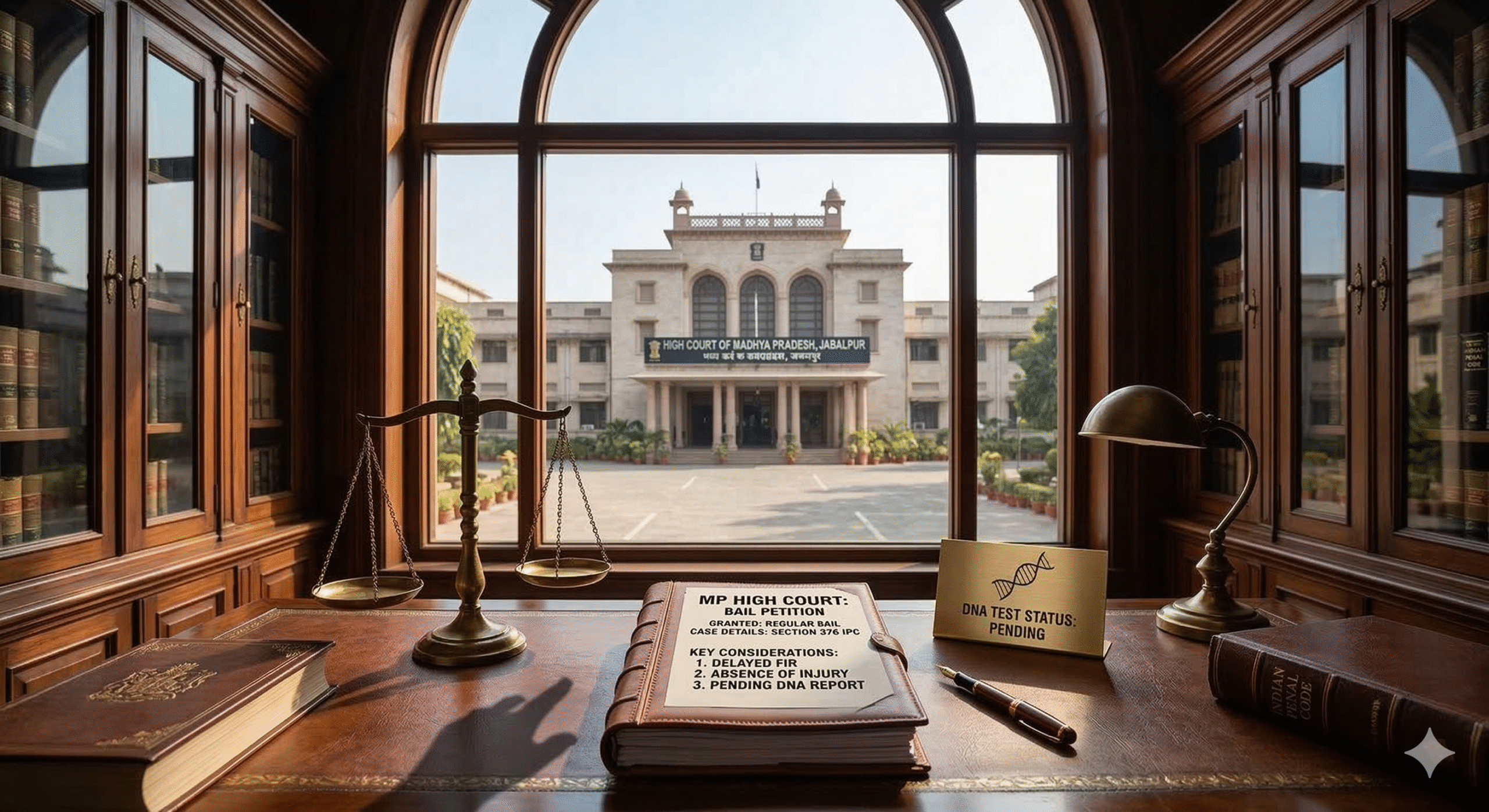
In sexual assault cases, courts are called upon to strike a careful balance between the gravity of the alleged offence and the established principles of bail jurisprudence. Factors such as delay in lodging the FIR, inconsistencies in the complainant’s statements, absence of corroborating medical evidence, and the pendency of forensic examination reports are all relevant considerations that courts must weigh while deciding bail applications. The High Court of Madhya Pradesh at Jabalpur examined precisely these factors in MCRC No. 7550 of 2025, decided on 18 February 2025 before Hon’ble Justice Devnarayan Mishra.
Background of the Case
The applicant, Babbu @ Mohd. Tufel, filed his first application under Section 483 of the Bharatiya Nagarik Suraksha Sanhita, 2023 read with Section 439 of the Code of Criminal Procedure, 1973 seeking regular bail in connection with FIR/Crime No. 662/2024 registered at Police Station Amiliya, District Sidhi, Madhya Pradesh.
The offences alleged were under:
| Provision | Subject |
|---|---|
| Section 64(2)(f), BNS 2023 | Rape — aggravated sexual assault |
| Section 351(3), BNS 2023 | Criminal intimidation |
Key Facts
The prosecution’s case rested on the following factual matrix:
- The applicant and the victim were first cousins — a relationship within which marriage is permitted in their community
- The victim had reportedly been interested in marrying the applicant, but the marriage did not take place and she was subsequently married to another person in Uttar Pradesh
- As per the prosecution, on the date of the alleged incident — 10 December 2024 — the victim was travelling with the applicant on a motorcycle when the alleged act took place
- However, no FIR was lodged on the date of the incident
- After the alleged incident, the victim accompanied the applicant and thereafter went to her husband’s home — without informing her husband of the incident
- The FIR was ultimately lodged on 15 December 2024 — five days after the alleged incident
- In her statement under Section 183 of CrPC, the victim changed her version of events
- Her statement to the Investigating Officer revealed that she first visited the Police Station on 14 December 2024 along with her father — after meeting her husband
- Medical examination revealed no injury on the victim’s body
- Only a vaginal slide was sent for FSL examination — a full DNA examination had not been conducted
- The victim had stayed with her husband for five days after the alleged incident before the FIR was lodged
Submissions on Behalf of the Applicant
Senior Advocate Shri Mrigendra Singh, appearing with Shri Jaideep Kaurav and Ms. Akanksha Singh Chauhan, advanced the following arguments:
1. Unnatural Delay in Lodging FIR The FIR was lodged five days after the alleged incident. If the applicant had truly violated the victim’s privacy, it would be natural for her to have immediately informed her husband. Her silence and continued association with the applicant after the incident raised serious questions about the prosecution’s version.
2. Inconsistencies in the Victim’s Statements The victim changed her story between her initial statement and her statement to the Investigating Officer. Such inconsistencies are relevant considerations at the bail stage, even though they are ultimately matters for trial.
3. Absence of Injury in Medical Examination The medical examination found no injury on the victim’s body — a factor that the defence argued was inconsistent with the nature of the alleged offence.
4. Incomplete Forensic Investigation Only the vaginal slide was sent for FSL examination. A full DNA examination had not been conducted. The applicant’s blood sample was taken and sent for DNA testing — the result of which was still awaited. The defence argued that if human sperm was found in the vaginal slide, no adverse inference could be drawn against the applicant given that the victim had stayed with her husband for five days after the alleged incident.
5. Prolonged Trial The trial was expected to take considerable time, making continued incarceration during the pendency of trial disproportionate.
State’s Opposition
The learned Panel Lawyer for the State opposed the bail application on the following grounds:
- The vaginal slide of the victim was found positive
- The applicant’s blood sample had been sent for DNA examination
- The State questioned why a woman would falsely implicate her own cousin
- No case for bail was made out given the seriousness of the offence
The Court’s Decision
Hon’ble Justice Devnarayan Mishra, after hearing both sides and perusing the case diary, took note of the following key factors:
- The victim was a major and married woman
- The FIR was lodged five days after the alleged incident — a significant and unexplained delay
- The trial would take considerable time to conclude
Taking these circumstances into account, the Court deemed it appropriate to enlarge the applicant on bail and accordingly allowed the application — without commenting on the merits of the case.
Directions issued by the Court:
- The applicant Babbu @ Mohd. Tufel shall be released on bail on furnishing a personal bond of Rs. 50,000/- (Rupees Fifty Thousand) with one surety of the like amount, to the satisfaction of the trial Court
- The applicant shall appear before the trial Court on all dates fixed during the pendency of trial
- The applicant shall comply with all provisions of Section 480(3) of the BNSS, 2023
Legal Significance of This Order
This order raises several important points of law relevant to bail matters in sexual assault cases:
① Delay in FIR as a Relevant Bail Consideration While delay in lodging an FIR in sexual assault cases is not always fatal to the prosecution — courts have recognized that victims may delay due to trauma, fear, or social pressure — an unexplained five-day delay, combined with the victim’s continued association with the accused after the incident and her failure to inform her husband, is a factor that courts legitimately consider at the bail stage.
② Post-Incident Conduct of the Complainant The fact that the victim accompanied the applicant after the alleged incident and stayed with her husband for five days before lodging the FIR was noted as a relevant circumstance. Post-incident conduct, while not conclusive, forms part of the overall factual matrix that courts assess at the bail stage.
③ Absence of Corroborating Medical Evidence The absence of any injury in the medical examination was an important factor in this case. While absence of injury is not conclusive in sexual assault cases, it is a relevant consideration when weighed alongside other infirmities in the prosecution’s case.
④ Incomplete Forensic Investigation and Its Implications The Court implicitly acknowledged the significance of the pending DNA examination. The defence’s argument — that if sperm was found, it could not be attributed to the applicant given the victim’s cohabitation with her husband for five days — reflects an important principle: that forensic evidence must be viewed in its complete context, and that incomplete investigations can weigh in favour of bail pending trial.
⑤ Status of Victim as Adult Married Woman The Court specifically noted that the victim was a major and married woman. This is a relevant consideration in assessing the nature of the alleged offence and the surrounding circumstances, without in any way diminishing the seriousness of the charge.
⑥ Prolonged Trial as a Ground for Bail The Court’s observation that the trial would take considerable time reaffirms the well-established principle that indefinite pre-trial detention is inconsistent with the right to personal liberty under Article 21 of the Constitution of India.
Relevant Legal Provisions
| Provision | Subject |
|---|---|
| Section 483, BNSS 2023 | Regular Bail by High Court |
| Section 439, CrPC 1973 | Regular Bail — Predecessor Provision |
| Section 480(3), BNSS 2023 | Conditions on Release on Bail |
| Section 64(2)(f), BNS 2023 | Rape — Aggravated Sexual Assault |
| Section 351(3), BNS 2023 | Criminal Intimidation |
Conclusion
The Madhya Pradesh High Court’s order in Babbu @ Mohd. Tufel vs. State of Madhya Pradesh (MCRC 7550/2025) is an instructive example of how courts approach bail in sexual assault cases where the prosecution’s case is accompanied by significant procedural and evidentiary irregularities. The five-day delay in lodging the FIR, the absence of injury in medical examination, inconsistencies in the complainant’s statements, and the pendency of DNA examination were collectively treated as sufficient grounds to grant bail — without expressing any opinion on the ultimate guilt or innocence of the accused. The order is a useful reference for practitioners navigating bail applications in sensitive matters under the BNS and BNSS framework.