

Introduction
Forensic evidence has emerged as one of the most decisive tools in modern criminal litigation — and its exculpatory value is no less significant than its incriminating potential. In cases involving allegations of document forgery using digital means, the Forensic Science Laboratory report becomes the cornerstone of the prosecution’s case. Where that report fails to support the prosecution’s core allegation, it becomes a powerful ground for bail — even after multiple previous applications have been dismissed. The High Court of Madhya Pradesh at Jabalpur examined precisely this situation in MCRC No. 38841 of 2025, a case involving an elaborate land mutation fraud in District Singrauli.
Background of the Case
The applicant, Anil Kumar Verma, filed his fifth application under Section 483 of the Bharatiya Nagarik Suraksha Sanhita, 2023 seeking regular bail in connection with FIR/Crime No. 1065/2024 registered at Police Station Waidhan, District Singrauli, Madhya Pradesh.
The applicant had been in judicial custody since 06 October 2024.
The offences alleged were under the following provisions of the Bharatiya Nyaya Sanhita, 2023:
| Section | Subject |
|---|---|
| Section 318(4) | Cheating — causing delivery of property |
| Section 336(2) | Forgery for the purpose of cheating |
| Section 338 | Making or possessing counterfeit seal |
| Section 336(3) | Forgery of valuable security |
| Section 340(2) | Using as genuine a forged document |
| Section 61(2) | Criminal conspiracy |
History of Previous Applications:
| Application | Case No. | Outcome |
|---|---|---|
| 1st | M.Cr.C. 2277/2025 | Dismissed as withdrawn — 27.01.2025 |
| 2nd | M.Cr.C. 8763/2025 | Dismissed on merits — 21.03.2025 |
| 3rd | M.Cr.C. 16632/2025 | Dismissed as withdrawn — 21.04.2025 |
| 4th | M.Cr.C. 23494/2025 | Dismissed as withdrawn — 10.07.2025 |
| 5th | M.Cr.C. 38841/2025 | Allowed — 27.10.2025 |
The Prosecution’s Case — A Land Mutation Fraud
The case arose from a complex land mutation fraud in the Municipal Area of Singrauli. The full factual matrix as recorded by the Court is as follows:
Co-accused Rambabu Vaishya had purchased agricultural land bearing Survey No. 715/1(s) from Jayram Shah and Mahendra Sahu. Subsequently, Mahendra Sahu sold the same land to Anita Shah on 12 December 2022 — creating a competing title.
Rambabu Vaishya filed mutation proceedings before the Sub Divisional Officer, Singrauli (Revenue Case No. 0030/2023-24), appointing Surendra Bahadur Singh as his counsel. During this period, Rambabu Vaishya came into contact with two individuals — Raghvendra Gupta and Ashok Gupta — who accepted Rs. 1,20,000/- and Rs. 1,30,000/- respectively from him with the promise of securing a favourable mutation order.
The duo subsequently informed Rambabu Vaishya that his land had already been mutated on 12 July 2024. When his counsel Surendra Bahadur Singh applied for a certified copy of the mutation order, incomplete order-sheets were supplied — but the land was shown as mutated in Rambabu Vaishya’s favour.
Investigation revealed that a forged Revenue order dated 01 July 2024 — complete with fabricated seal and signature of the Sub Divisional Officer — had been created and submitted before the concerned Patwari, who then mutated the land based on this forged document.
The prosecution alleged that the present applicant — who runs a computer typing and printing shop — had prepared this forged document on his computer in conspiracy with the other accused persons.
The Decisive FSL Finding
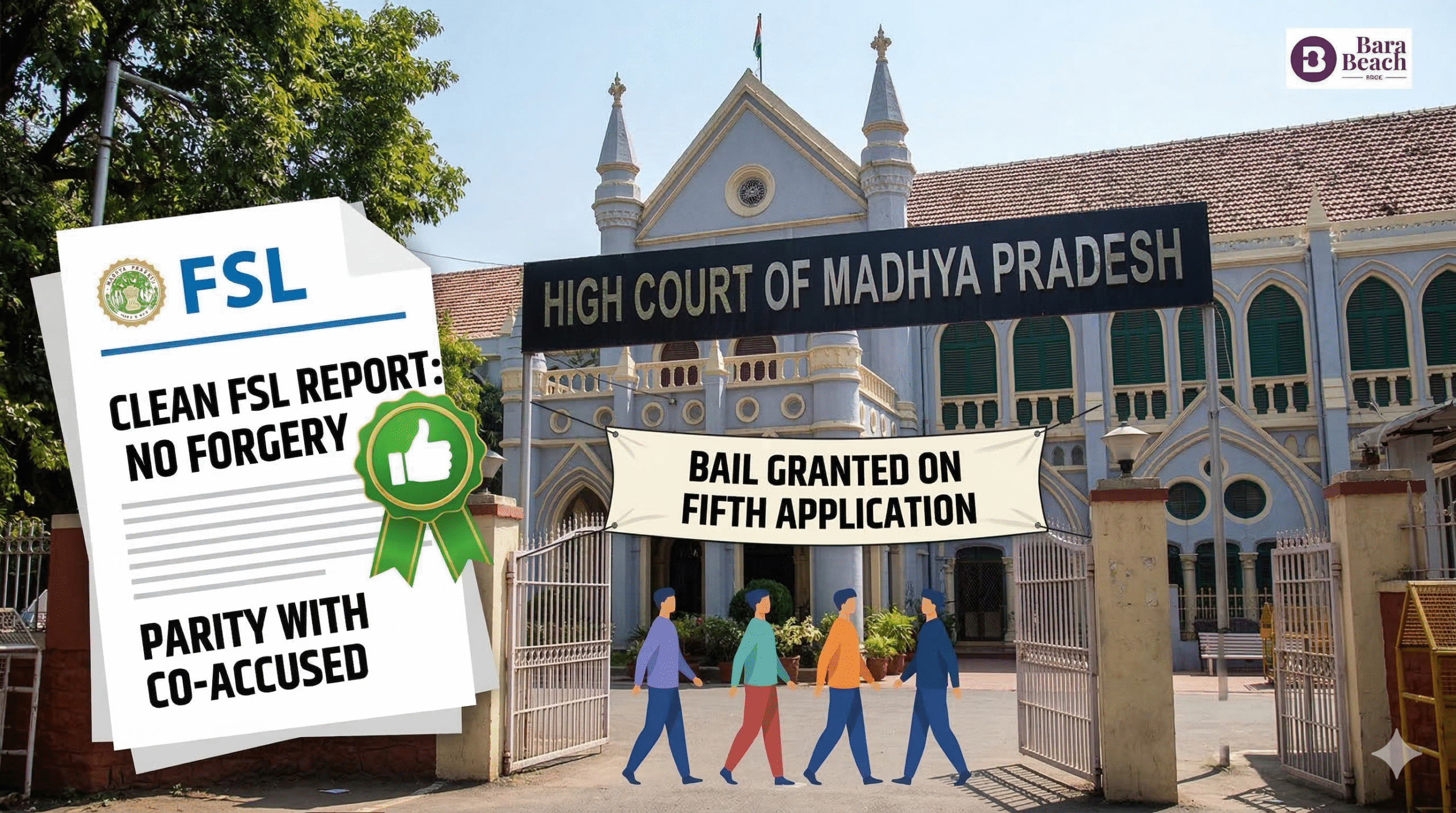
The pivotal development that ultimately led to the grant of bail was the Forensic Science Laboratory report. The FSL examined the hard disk drive recovered from the applicant’s computer — and found no such forged document or order on the hard disk.
This forensic finding directly contradicted the prosecution’s central allegation that the forged document had been prepared on the applicant’s computer.
Submissions on Behalf of the Applicant
Senior Advocate Shri Mrigendra Singh, appearing through video conferencing assisted by Shri Jaydeep Kourav, advanced the following key arguments:
1. FSL Report Clears the Applicant The FSL report — the most objective and scientific piece of evidence in the case — found no forged document on the applicant’s computer. This fundamentally undermined the prosecution’s case against him.
2. Parity with Co-Accused Both co-accused Surendra Bahadur Singh and the beneficiary Rambabu Vaishya had already been granted bail. The applicant’s case was not materially different — and indeed stronger, given the exculpatory FSL report.
3. Extended Period of Custody The applicant had been in custody since 06 October 2024 — over a year by the time of hearing — while similarly placed co-accused persons were at liberty on bail.
4. Prolonged Trial The trial was still pending and would take considerable time to conclude, making continued incarceration disproportionate.
State’s Opposition
The learned Deputy Government Advocate opposed the application, contending that the forged document had been prepared by the applicant and that he was the main offender in the case. It was urged that no case for bail was made out.
The Court’s Decision
Hon’ble Justice Devnarayan Mishra, after hearing both sides and perusing the case diary, took note of the following:
- The co-accused persons had already been enlarged on bail
- The forensic report clearly showed the forged document was not found on the applicant’s computer
- The trial would take considerable time to conclude
Taking all these factors together, the Court deemed it appropriate to grant bail and accordingly allowed the application — without commenting on the merits of the case.
Directions issued by the Court:
- The applicant shall be released on bail on furnishing a personal bond of Rs. 50,000/- (Rupees Fifty Thousand) with one solvent surety of the like amount, to the satisfaction of the trial Court
- The applicant shall appear before the trial Court on all dates fixed during the pendency of trial
- The applicant shall comply with all provisions of Section 480(3) of the BNSS, 2023
Legal Significance of This Order
This order raises several important legal principles of broad applicability:
① Exculpatory FSL Report as a Ground for Bail Where the prosecution’s case is built on the allegation that a specific accused prepared a forged document on his computer, and the FSL report finds no such document on the hard drive, the forensic evidence directly undermines the basis of the charge. Courts are entitled to — and should — give significant weight to such exculpatory forensic findings at the bail stage, even without pronouncing on guilt or innocence.
② Bail Granted on Fifth Application — Changed Circumstances The grant of bail on the fifth application — after earlier applications were dismissed or withdrawn — reflects an important principle: a subsequent bail application is maintainable where there is a change in circumstances. The availability of the FSL report, which had not been placed before the Court in earlier applications, constituted such a changed circumstance justifying fresh consideration.
③ Parity Principle — Beneficiary on Bail, Alleged Maker Also Entitled The fact that Rambabu Vaishya — the alleged beneficiary of the forged document — had already been granted bail, while the applicant alleged to have prepared the document remained in custody despite the exculpatory FSL report, created a compelling parity argument that the Court accepted.
④ Digital Forensics in Criminal Cases This order highlights the growing importance of digital forensic evidence — particularly hard disk analysis — in criminal cases involving allegations of document forgery using computers. A clean forensic report is a powerful exculpatory tool that practitioners should actively deploy at the bail stage.
⑤ Extended Custody Period as a Relevant Consideration The applicant had been in custody for over a year by the time bail was granted. Courts have consistently recognized that prolonged pre-trial detention, particularly where the forensic evidence is not corroborative of the prosecution’s case, is inconsistent with the constitutional right to personal liberty.
Relevant Legal Provisions
| Provision | Subject |
|---|---|
| Section 483, BNSS 2023 | Regular Bail by High Court |
| Section 480(3), BNSS 2023 | Conditions on Release on Bail |
| Section 318(4), BNS 2023 | Cheating |
| Section 336(2), BNS 2023 | Forgery for Purpose of Cheating |
| Section 338, BNS 2023 | Counterfeit Seal |
| Section 61(2), BNS 2023 | Criminal Conspiracy |
Conclusion
The Madhya Pradesh High Court’s order in Anil Kumar Verma vs. State of Madhya Pradesh (MCRC 38841/2025) is a significant case study in how forensic evidence can decisively shift the bail calculus in document forgery cases. The FSL report finding no forged document on the applicant’s computer directly contradicted the prosecution’s central allegation — and when combined with the parity argument arising from co-accused persons already being on bail and the applicant’s extended period of custody, it presented a compelling case for bail that the Court rightly accepted. For practitioners handling forgery, fraud, and digital evidence cases, this order is a valuable and practically relevant reference.