

Introduction
In dowry death cases, the dying declaration and the FIR are typically the two most powerful pieces of evidence shaping the course of the prosecution. However, when the deceased’s own parents — the persons closest to her and most invested in seeing justice done — file an affidavit denying any harassment or dowry demand, it creates a remarkable evidentiary situation that courts cannot ignore, even at the bail stage. The High Court of Madhya Pradesh at Jabalpur confronted precisely this situation in MCRC No. 55678 of 2025, the third bail order to emerge from Crime No. 409/2025, District Rewa — a case that has already been analysed in two earlier articles on this page in the context of the father-in-law (MCRC 127/2026) and the sister-in-law (MCRC 50358/2025).
Background of the Case
The applicant, Kanti Singh, is the mother-in-law of the deceased — Anjali Singh — whose marriage was solemnized with Rahees Singh on 20 June 2021. She filed her first application under Section 482 of the Bharatiya Nagarik Suraksha Sanhita, 2023 seeking anticipatory bail in connection with Crime No. 409/2025 registered at Police Station Churhata, District Rewa, Madhya Pradesh.
The offences alleged were under:
| Provision | Subject |
|---|---|
| Section 85, BNS 2023 | Cruelty by husband or his relatives |
| Section 80(2), BNS 2023 | Abetment of suicide |
| Sections 3 & 4, Dowry Prohibition Act | Prohibition of giving or taking dowry |
The prosecution’s case in brief was that the applicant, along with co-accused persons, subjected the deceased Anjali Singh to continuous cruelty and harassment due to non-satisfaction of dowry demand, which ultimately led to Anjali committing suicide by consuming a poisonous substance on 03 July 2025.
This Case in Its Broader Context
This is the third bail order arising from Crime No. 409/2025. The High Court had previously considered the same FIR in:
| Case | Applicant | Relationship | Order |
|---|---|---|---|
| MCRC 50358/2025 | Rashmi Singh | Sister-in-law | Anticipatory bail granted — 25.11.2025 |
| MCRC 55678/2025 | Kanti Singh | Mother-in-law | Anticipatory bail granted — 26.12.2025 |
| MCRC 127/2026 | Dilraj Singh | Father-in-law | Anticipatory bail granted — 27.01.2026 |
The consistent grant of bail to all three family members across three separate orders is itself a significant indicator of how the Court assessed the overall strength of the prosecution’s case.
Key Facts
Several materially significant circumstances distinguished this case and weighed in favour of the applicant:
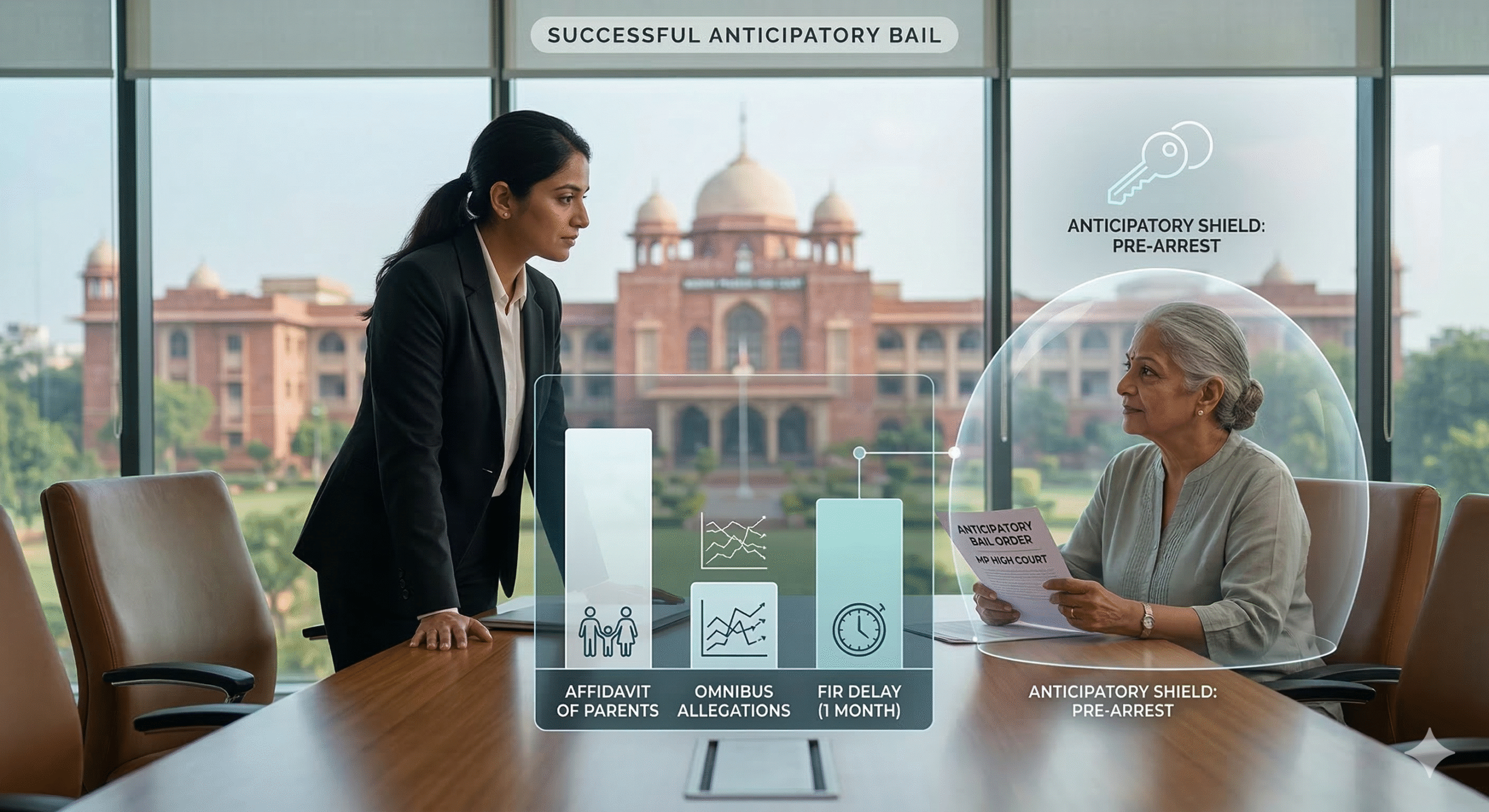
1. FIR Registered One Month After the Incident The deceased committed suicide on 03 July 2025. The FIR was registered approximately one month after the incident — a significant and unexplained delay that the defence highlighted as casting doubt on the authenticity of the prosecution’s narrative.
2. Omnibus Allegations in Both FIR and Dying Declaration While the dying declaration named the applicant, even the State counsel fairly conceded before the Court that the allegations against the applicant in the dying declaration were omnibus in nature — vague and general, without any specific act of harassment or dowry demand being attributed to her individually.
3. Affidavit of Deceased’s Parents — A Remarkable Development The most striking feature of this case was the affidavit filed by the parents of the deceased — given soon after the incident — in which they stated that they did not support the prosecution’s story. Specifically, the affidavit of the father of the deceased clearly demonstrated that there was no harassment or demand of dowry at any point of time. This affidavit was verified by the State counsel pursuant to a direction given by the Court on 16 December 2025 — and after verification, the State counsel fairly submitted that the parents had indeed given such an affidavit.
4. Primary Allegations Against the Husband The main and specific allegations in the case were directed against the husband of the deceased — not the applicant. The applicant’s role, as reflected in the dying declaration, was peripheral and omnibus.
5. Suicide at Parental Home The deceased’s death occurred at her parental home — not at the matrimonial home — a circumstance that raises questions about the causal connection between the alleged acts of the matrimonial family and the deceased’s ultimate act.
6. Applicant’s Age and Gender The applicant is a woman aged approximately 63 years — a senior citizen — who expressed her readiness to cooperate with the investigation and abide by all conditions imposed by the Court.
7. Parity with Co-Accused Rashmi Singh Co-accused Rashmi Singh — the sister-in-law of the deceased — had already been granted anticipatory bail by the same High Court vide order dated 25 November 2025 in MCRC 50358/2025. The applicant’s position, as the mother-in-law against whom similarly omnibus allegations existed, was comparable.
Submissions on Behalf of the Applicant
Senior Advocate Shri Mrigendra Singh, appearing with Ms. Akanksha Singh through video conferencing, placed all the above grounds before the Court, with particular emphasis on the affidavit of the deceased’s parents and the omnibus nature of the allegations in the dying declaration.
State’s Response — A Notable Concession
The State’s response in this case is particularly noteworthy. While the Panel Lawyer initially opposed the application on the ground that the dying declaration named the applicant, he made two important concessions:
- He fairly submitted that the allegations against the applicant in the dying declaration were omnibus in nature
- After the affidavit of the deceased’s parents was verified pursuant to the Court’s direction of 16 December 2025, he fairly submitted that the parents had indeed given an affidavit not supporting the prosecution’s story
These concessions by the State counsel are significant — they reflect the Court’s active engagement with the evidence and its direction to verify the affidavit before proceeding to decide the bail application.
The Court’s Decision
Hon’ble Justice Vishal Mishra, considering the overall facts and circumstances, allowed the anticipatory bail application — subject to verification of the fact that the husband of the deceased had surrendered. The order was passed without commenting on the merits of the case.
Directions issued by the Court:
- In the event of arrest, the applicant shall be released on bail on furnishing a personal bond of Rs. 50,000/- (Rupees Fifty Thousand) with one surety of the like amount, to the satisfaction of the Arresting Officer
- The applicant shall mark her presence before the concerned Police Station in the first week of every month until the completion of investigation and filing of charge-sheet
- Failure to cooperate with investigation shall result in automatic cancellation of bail
The Court imposed a comprehensive set of conditions, including:
- Full compliance with bond terms
- Cooperation in investigation and trial
- No inducement, threat, or promise to any person acquainted with the facts
- No involvement in any other criminal case — failing which bail stands automatically cancelled
- No unnecessary adjournments during trial
- No departure from India without prior permission of the trial Court or Investigating Officer
- Intimation of residential address to the concerned SHO, with the Public Prosecutor directed to send an e-copy of the order to the concerned SHO and Superintendent of Police
Legal Significance of This Order
This order is one of the most factually rich bail orders to emerge from this series of cases, and carries several important legal lessons:
① Affidavit of Deceased’s Parents — A Powerful and Underutilized Tool The most significant feature of this order is the weight given to the affidavit of the deceased’s own parents. In dowry death cases, the parents of the deceased are typically the primary complainants. When they file an affidavit denying any harassment or dowry demand, it creates a direct contradiction to the prosecution’s narrative that courts cannot brush aside. This is a powerful evidentiary tool that practitioners should actively consider deploying in appropriate cases.
② Court-Directed Verification of Affidavit The Court’s direction on 16 December 2025 to verify the affidavit — and the State counsel’s subsequent concession after verification — reflects a commendably rigorous approach to evidence at the bail stage. Courts are entitled to direct verification of material documents before deciding bail applications, and this order is an illustration of that practice.
③ State’s Fair Concession on Omnibus Allegations The State counsel’s concession that the allegations in the dying declaration were omnibus in nature was a significant acknowledgment. It reflects the principle that even the prosecution is bound by its duty of fairness to the Court, and that omnibus allegations — even in a dying declaration — carry limited evidentiary weight against specific accused persons.
④ Conditional Bail — Husband’s Surrender as a Precondition The Court’s condition that the bail order would operate subject to verification of the husband’s surrender is a noteworthy feature. Where the husband is the primary accused and faces the most specific allegations, his surrender ensures that the most culpable person is brought within the reach of the law before peripheral family members are released on bail.
⑤ Monthly Appearance Before Police Station The direction to mark presence before the Police Station in the first week of every month until charge-sheet is filed is a structured accountability mechanism that courts are increasingly using in sensitive cases. It ensures the accused remains accessible to the investigation without being in custody.
⑥ Comprehensive Conditions — Raising the Bar for Compliance This order contains one of the most comprehensive sets of bail conditions in this series, including restrictions on leaving India, prohibition on seeking unnecessary adjournments, and the automatic cancellation of bail on involvement in any other offence. These conditions reflect the Court’s recognition of the sensitivity of the case while still upholding the applicant’s right to personal liberty.
Relevant Legal Provisions
| Provision | Subject |
|---|---|
| Section 482, BNSS 2023 | Anticipatory Bail |
| Section 85, BNS 2023 | Cruelty by Husband or Relatives |
| Section 80(2), BNS 2023 | Abetment of Suicide |
| Sections 3 & 4, Dowry Prohibition Act | Prohibition of Dowry |
Conclusion
The Madhya Pradesh High Court’s order in Kanti Singh vs. State of Madhya Pradesh (MCRC 55678/2025) stands out as one of the most analytically significant bail orders in the series arising from Crime No. 409/2025. The combination of a one-month delay in the FIR, omnibus allegations in the dying declaration, the affidavit of the deceased’s own parents denying any harassment or dowry demand, the suicide occurring at the parental home, and parity with a co-accused already on bail collectively created an overwhelming case for anticipatory bail. The State’s fair concessions and the Court’s direction to verify the affidavit before deciding the application further enhance the evidentiary rigour of this order. For practitioners handling dowry death cases — particularly those involving peripheral family members — this order, read alongside MCRC 50358/2025 and MCRC 127/2026, provides a comprehensive and practically valuable framework for bail strategy.