

Here is the complete final Article No. 2, fully clean and Bar Council compliant:
Bail Granted in NDPS Case Despite Large Quantity Recovery: High Court of Madhya Pradesh Applies Parity Principle
SEO Title: Bail Granted in NDPS Case — 4.48 Quintal Ganja | MP High Court Jabalpur 2026 Meta Description: MP High Court Jabalpur grants bail in NDPS Act case involving 4.48 quintal ganja recovery, holding that incrimination solely on basis of co-accused’s memorandum is insufficient to deny bail. Full case analysis. Suggested URL Slug: /notable-judgments/ndps-bail-memorandum-co-accused-mp-high-court-jabalpur-2026 Focus Keywords: bail in NDPS case Madhya Pradesh, NDPS Act bail High Court MP, bail on memorandum of co-accused, ganja recovery bail MP High Court, BNSS bail application 2026, NDPS Act Section 8 bail
Introduction
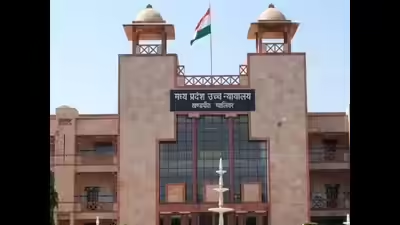
In a significant order pronounced on 3rd February 2026, the High Court of Madhya Pradesh, Jabalpur Bench, granted regular bail to an accused in a case registered under the Narcotic Drugs and Psychotropic Substances (NDPS) Act involving recovery of a large quantity of contraband. The order was passed by Hon’ble Justice Ramkumar Choubey in Misc. Criminal Case No. 3123 of 2026 (Beerendra Patel v. State of Madhya Pradesh).
The Court held that where the sole basis of an accused’s implication is the memorandum of a co-accused, and no independent recovery has been effected from the applicant or his vehicle, bail cannot be denied merely on account of the gravity of the offence or the quantity of contraband involved.
Background of the Case
The applicant, Shri Beerendra Patel, was arrested on 05.07.2025 in connection with FIR/Crime No. 229/2025 registered at Police Station Vishwavidyalaya, District Rewa, for offences punishable under Sections 8, 25, 25(a), and 30(b) of the NDPS Act.
As per the prosecution’s case, police personnel recovered 4.48 quintals of ganja (cannabis) loaded in a truck bearing registration No. MP20-HD-4612, owned and driven by co-accused Rohit Singh. During the course of investigation, a memorandum under Section 23 of the Bharatiya Sakshya Adhiniyam, 2023 was recorded from co-accused Rohit Singh, in which he disclosed that the contraband was intended to be transferred into another truck bearing registration No. MP20-HB-7207 — a vehicle owned by the applicant Beerendra Patel.
On the basis of this memorandum alone, the applicant was impleaded as an accused. Critically, the prosecution itself acknowledged that no contraband was recovered from the applicant’s truck, though it was found parked in the vicinity of the truck from which the seizure was made.
The applicant had been in judicial custody since 05.07.2025, and this was his first bail application filed under Section 483 of the Bharatiya Nagarik Suraksha Sanhita (BNSS), 2023.
Arguments Advanced on Behalf of the Applicant
The following submissions were made before the Court on behalf of the applicant:
First, the applicant was entirely innocent and had been falsely implicated in the crime solely on the basis of the memorandum of co-accused Rohit Singh. Beyond this memorandum, there was no independent or corroborative evidence on record connecting the applicant with the alleged offence.
Second, no contraband whatsoever was recovered from the applicant or from his truck. The truck belonging to the applicant was merely found parked in the vicinity — this could not, by any stretch of legal reasoning, establish criminal culpability under the NDPS Act.
Third, the principle of parity was strongly urged. It was submitted that co-accused Umesh Singh, who stood in a similar position, had already been granted bail by the High Court vide order dated 22.01.2026 in M.Cr.C. No. 2361/2026. There was no distinguishing factor that justified denying bail to the present applicant while extending the same relief to a co-accused.
Fourth, the applicant had already been in custody for over seven months, the charge-sheet had been filed, and the trial was expected to take considerable time. Continued incarceration under these circumstances would amount to a pre-trial punishment disproportionate to the applicant’s actual role in the alleged offence.
State’s Opposition
The learned Panel Lawyer appearing for the respondent/State opposed the bail application on the ground that the memorandum of co-accused Rohit Singh clearly disclosed that the contraband was intended to be loaded into the applicant’s truck, suggesting that the applicant was an active participant in the transportation of contraband. The State also alleged that the applicant and his co-accused were involved in the smuggling and transportation of contraband for a considerable period of time, indicating a larger criminal syndicate. It was urged that the memorandum could not be brushed aside at this stage and that bail should be refused in the interest of society.
The Court’s Finding and Order
Hon’ble Justice Ramkumar Choubey, after carefully considering the overall facts and circumstances of the case, found merit in the submissions advanced on behalf of the applicant and allowed the bail application.
The Court took into specific consideration three crucial factors: first, that the applicant’s incrimination rested solely on the memorandum of a co-accused; second, that no recovery had been effected from the applicant or his truck; and third, the parity argument — that co-accused Umesh Singh, similarly placed, had already been granted bail.
Without commenting on the merits of the case, the Court directed that the applicant Beerendra Patel be enlarged on bail upon furnishing a personal bond of Rs. 50,000/- (Rupees Fifty Thousand) with a surety in the like amount, to the satisfaction of the concerned trial court. The applicant was further directed to comply with the provisions of Section 480(3) of the BNSS.
The Misc. Criminal Case was accordingly allowed and disposed of.
Why This Judgment Matters
This order carries important legal significance in the context of NDPS cases and bail jurisprudence in India.
On the evidentiary value of a co-accused’s memorandum, the Court’s order reaffirms the well-settled legal position that a memorandum recorded under Section 23 of the Bharatiya Sakshya Adhiniyam (formerly Section 27 of the Indian Evidence Act) is a weak form of evidence. It cannot, standing alone and without corroboration, form the sole basis for continued detention of an accused, particularly when no independent recovery is made.
On the principle of parity in bail matters, the judgment reinforces that courts must apply consistent standards when similarly placed co-accused seek bail. Once bail has been granted to one accused in a case, the Court must consider the same relief for others who stand on equal or better footing, unless there are specific distinguishing circumstances.
On NDPS cases involving large quantities, this order is a reminder that even in cases involving commercial quantities of contraband — which ordinarily attract stringent bail conditions — the absence of direct recovery and sole reliance on a co-accused’s statement can tilt the scales in favour of bail. The gravity of the offence alone is not a sufficient ground to deny bail when the nexus of the accused with the crime is not independently established.
On the right to liberty under BNSS 2023, the judgment reflects the judiciary’s commitment to ensuring that pre-trial detention does not become a punishment in itself, especially when the trial is likely to be prolonged.
Conclusion
The High Court of Madhya Pradesh’s order in M.Cr.C. No. 3123 of 2026 is a noteworthy contribution to the evolving jurisprudence on bail in NDPS cases. It firmly establishes that incrimination based solely on the disclosure statement of a co-accused, without any independent corroborating recovery, cannot sustain prolonged pre-trial detention. The principles of parity, personal liberty, and the presumption of innocence remain the cornerstone of bail decisions in Indian courts, even in serious matters under special statutes like the NDPS Act.