

Introduction
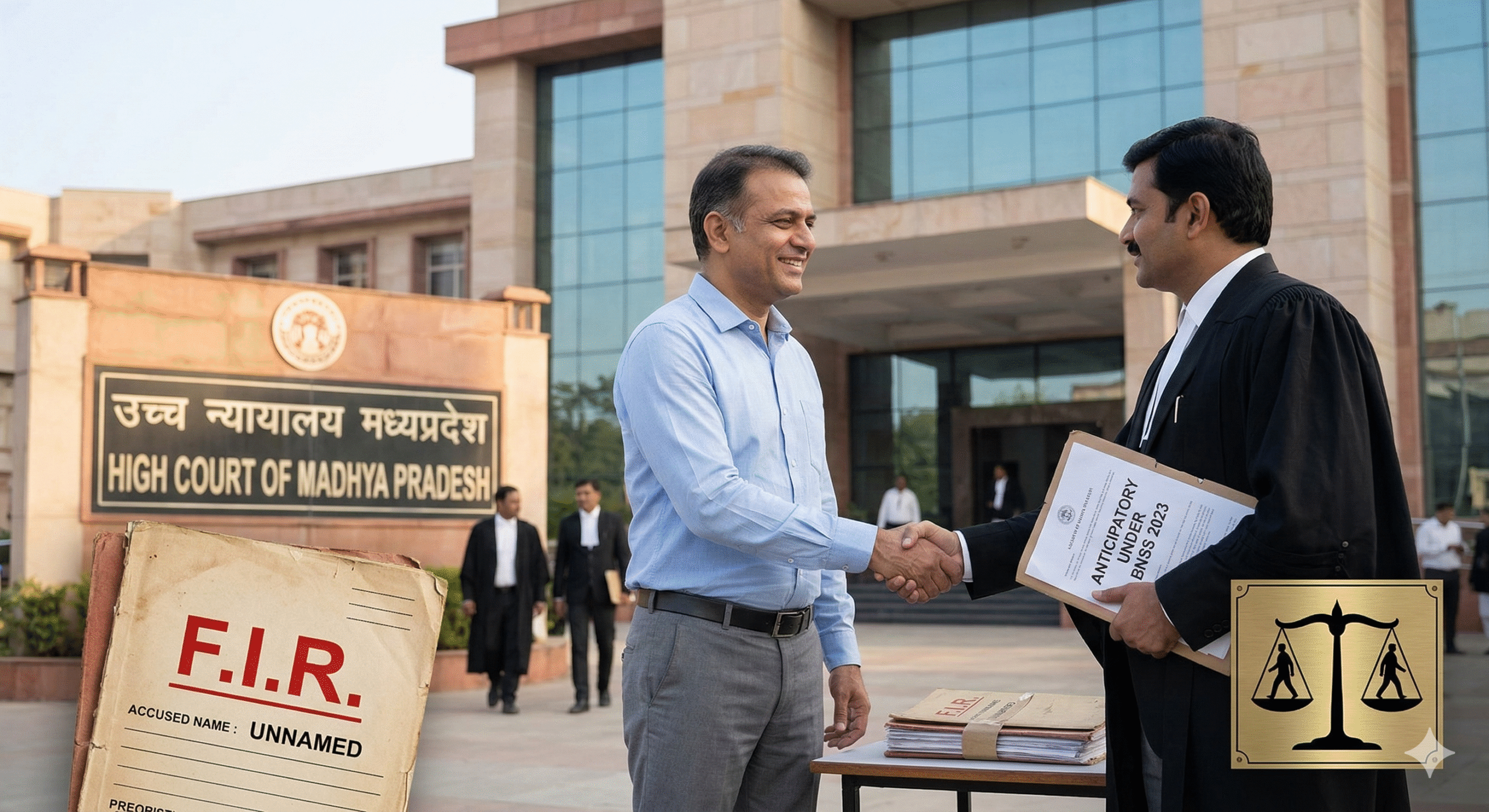
In criminal law, the absence of an accused’s name from the FIR itself is a significant factor that courts weigh carefully while deciding anticipatory bail applications. When such an accused is later implicated solely on the basis of memorandums and witness statements — and when similarly placed co-accused have already been granted bail — the question of pre-arrest bail takes on added importance. The High Court of Madhya Pradesh at Jabalpur addressed precisely this situation in MCRC No. 2643 of 2026, decided on 29 January 2026 before Hon’ble Justice Devnarayan Mishra.
Background of the Case
The applicant, Angad Prasad Saket, filed his first application under Section 482 of the Bharatiya Nagarik Suraksha Sanhita, 2023 seeking anticipatory bail in connection with Crime No. 914/2025 registered at Police Station Kotwali, District Sidhi, Madhya Pradesh.
The offences alleged were under the following provisions of the Bharatiya Nyaya Sanhita, 2023:
| Section | Subject |
|---|---|
| Section 103(1) | Murder |
| Section 296 | Obscene acts |
| Section 109 | Attempt to commit offences |
| Section 115(2) | Voluntarily causing grievous hurt |
| Section 118(1) | Voluntarily causing hurt by dangerous weapons |
| Section 333 | House trespass to commit offence |
| Section 351(3) | Criminal intimidation |
| Section 3(5) | Common intention |
Key Facts
A critical fact at the heart of this case was that the applicant Angad Prasad Saket was not named in the FIR. He was subsequently made an accused solely on the basis of a memorandum and statements of prosecution witnesses recorded during the course of investigation — a circumstance that carried significant weight in the Court’s consideration.
Additionally, two co-accused in the same case — Trilok and Jagdev Saket — had already been granted bail by the same High Court vide orders dated:
- 18 November 2025 in M.Cr.C. No. 53656/2025
- 08 December 2025 in M.Cr.C. No. 57269/2025
Submissions on Behalf of the Applicant
Senior Advocate Shri Mrigendra Singh Baghel, appearing with Ms. Akanksha Singh Chauhan for the applicant, advanced the following arguments:
1. False Implication The applicant was innocent and had been falsely implicated in the case without any credible basis.
2. Not Named in FIR The applicant’s name did not appear in the original FIR. His subsequent inclusion as an accused was based only on a memorandum and statements of prosecution witnesses — making his implication procedurally weaker compared to accused persons named at the outset.
3. Parity with Co-Accused The case of the applicant was not materially different from that of co-accused Trilok and Jagdev Saket, both of whom had already been granted anticipatory bail by the High Court. The principle of parity therefore strongly favoured the applicant’s case.
State’s Opposition
The learned Panel Lawyer for the State opposed the application, contending that the applicant was involved in the offence and therefore not entitled to the benefit of anticipatory bail.
The Court’s Decision
After hearing both sides and perusing the case diary, Hon’ble Justice Devnarayan Mishra, taking into account the factual aspects of the case and the previous orders of the Court and trial court, deemed it fit to grant anticipatory bail to the applicant.
The application was allowed, with the following directions:
- In the event of arrest, the applicant shall be released on bail upon furnishing a personal bond of Rs. 50,000/- (Rupees Fifty Thousand) with one solvent surety of the like amount, to the satisfaction of the Arresting Officer
- The applicant shall cooperate with the investigating agency and appear before the Investigating Officer on dates and times directed
- The applicant shall not directly or indirectly induce or threaten any prosecution witness
- The applicant shall regularly appear before the trial Court and cooperate till disposal of the case
- The applicant shall abide by all conditions under Section 482(2) of the BNSS, 2023
The order was passed without commenting on the merits of the case.
Legal Significance of This Order
This order highlights several important principles relevant to anticipatory bail jurisprudence under the new criminal law framework:
① Absence from FIR as a Relevant Factor Where an accused has not been named in the original FIR and has been subsequently implicated through memorandums or witness statements alone, courts treat this as a factor weighing in favour of bail. The credibility and basis of subsequent implication is always open to scrutiny at the bail stage.
② The Parity Principle in Anticipatory Bail The parity principle — that similarly placed co-accused who have been granted bail create a legitimate ground for other accused persons to seek the same relief — is well established in Indian bail jurisprudence. This order is a clear application of that principle. When no distinguishing circumstance exists between the applicant and co-accused who have already been granted bail, denial of bail to the applicant becomes difficult to justify.
③ Previous Orders of the Court as Persuasive Precedent The Court explicitly noted the previous orders granting bail to co-accused as a relevant consideration. This reflects the judicial practice of maintaining consistency across connected matters arising from the same FIR, unless there are specific and cogent reasons to differentiate.
④ Standard Conditions Under Section 482(2) BNSS The direction to abide by all conditions enumerated under Section 482(2) of the BNSS is now a standard feature of anticipatory bail orders under the new framework. These conditions — which include cooperation with investigation, non-tampering with evidence, and regular appearance — ensure that bail does not become an obstacle to a fair investigation or trial.
Relevant Legal Provisions
| Provision | Subject |
|---|---|
| Section 482, BNSS 2023 | Anticipatory Bail |
| Section 482(2), BNSS 2023 | Mandatory Conditions for Anticipatory Bail |
| Section 103(1), BNS 2023 | Murder |
| Section 115(2), BNS 2023 | Voluntarily Causing Grievous Hurt |
| Section 351(3), BNS 2023 | Criminal Intimidation |
| Section 3(5), BNS 2023 | Common Intention |
Conclusion
The Madhya Pradesh High Court’s order in Angad Prasad Saket vs. State of Madhya Pradesh (MCRC 2643/2026) reinforces two foundational principles of anticipatory bail law in India — the significance of an accused not being named in the FIR, and the application of the parity principle where co-accused have already been granted bail. Read together with the growing body of BNSS-era bail jurisprudence emerging from the Jabalpur High Court, this order serves as a valuable reference for criminal law practitioners across Madhya Pradesh and beyond.