

Introduction
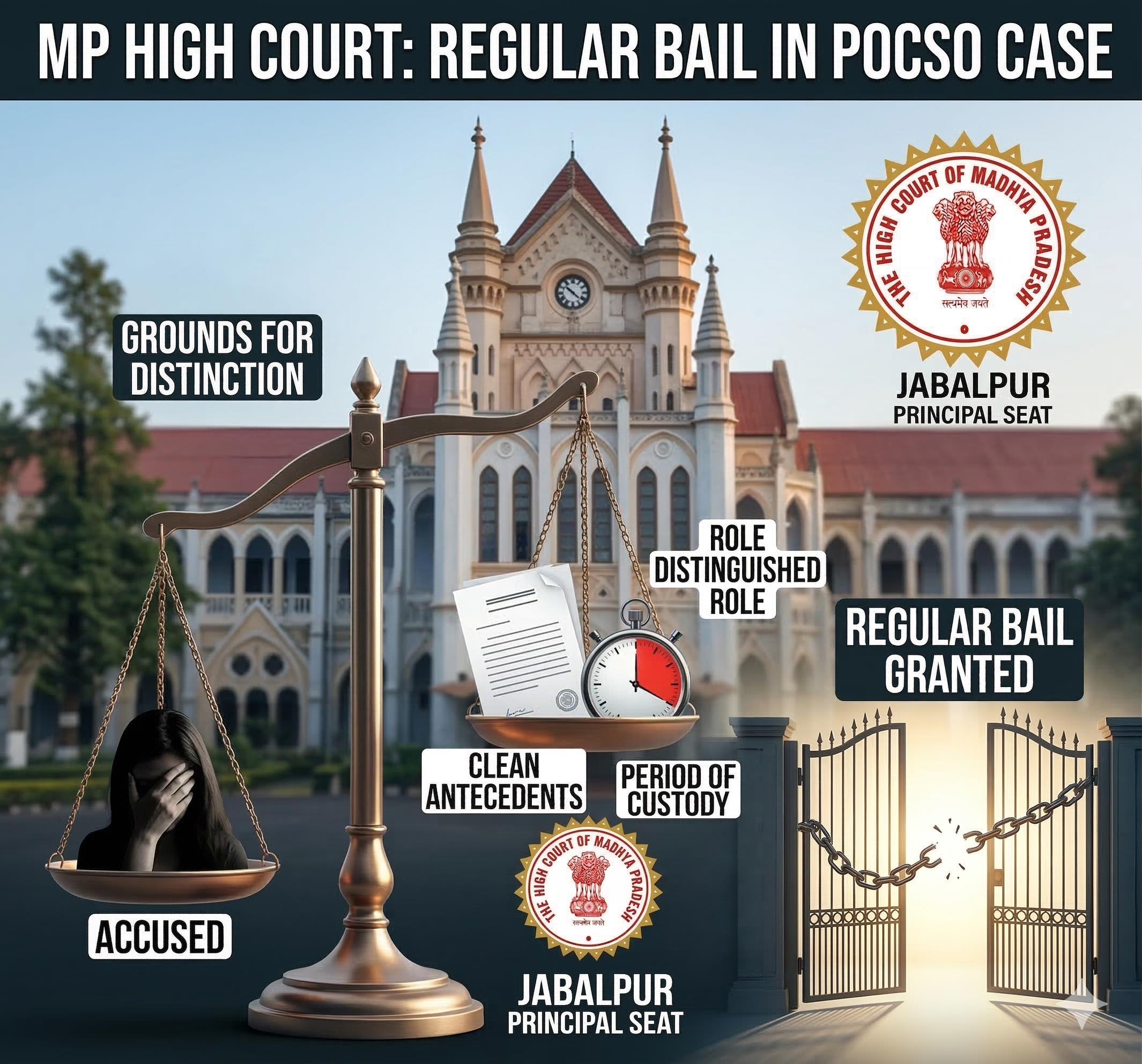
In cases involving multiple accused persons, one of the most critical — and often overlooked — principles of bail jurisprudence is that each accused must be assessed individually based on their specific role in the alleged offence. Mere presence at the scene of crime, without active participation, cannot automatically be treated as equivalent to the role of the principal offender. The High Court of Madhya Pradesh at Jabalpur applied this principle with clarity in MCRC No. 11343 of 2025, a case involving serious charges under both the Bharatiya Nyaya Sanhita, 2023 and the Protection of Children from Sexual Offences Act, 2012.
Background of the Case
The applicant, Pankaj Pandey @ Pankaj Gautam, filed his second application under Section 483 of the Bharatiya Nagarik Suraksha Sanhita, 2023 seeking regular bail in connection with Crime No. 642/2024 registered at Police Station Jamodhi Sidhi, District Sidhi, Madhya Pradesh.
His first bail application (M.Cr.C. No. 972/2025) had been dismissed as withdrawn on 20 January 2025.
The applicant had been in judicial custody since 11 October 2024.
The offences alleged were under the following provisions:
| Provision | Subject |
|---|---|
| Section 137(2), BNS 2023 | Kidnapping |
| Section 74, BNS 2023 | Assault or use of criminal force with intent to outrage modesty |
| Section 308(2), BNS 2023 | Extortion |
| Section 107, BNS 2023 | Abetment |
| Section 61(2), BNS 2023 | Criminal conspiracy |
| Section 3(5), BNS 2023 | Common intention |
| Sections 7 & 8, POCSO Act 2012 | Sexual assault on a child |
Key Facts
The prosecution’s own case revealed a crucial distinction between the applicant and the other accused persons. Specifically:
- The applicant was present at the spot along with other co-accused but did not actively participate in the assault
- No recording of the incident was made by the applicant
- The mobile phone seized in connection with the case belonged to another accused, not the applicant
- The motorcycle used in the crime also belonged to another accused
- The applicant had no past criminal antecedents and no prior case registered against him
- The bail application of a co-accused was rejected by the Court specifically on account of his past criminal antecedents — a ground entirely absent in the applicant’s case
Submissions on Behalf of the Applicant
Senior Advocate Shri Mrigendra Singh, appearing with Ms. Akanksha Singh Chauhan, advanced the following key arguments:
1. Limited and Passive Role Even as per the prosecution’s own witnesses, the applicant had not committed any overt act. He had neither recorded the incident nor used the mobile phone, and neither the mobile nor the motorcycle — the key instruments of the crime — belonged to him.
2. Clean Antecedents Unlike the co-accused whose bail was rejected, the applicant had no criminal history whatsoever. This was a materially distinguishing factor between the two.
3. Period of Custody The applicant had been in custody since 11 October 2024. The period of incarceration, viewed alongside his limited role, was urged as a strong ground for bail.
4. Age of the Applicant The applicant’s age was also placed before the Court as a relevant consideration in favour of granting bail.
Opposition by the State and Objector
The learned Government Advocate opposed bail, arguing that the mere fact that the applicant had not recorded the incident or used the mobile did not automatically entitle him to bail.
The counsel for the objector went further, contending that the applicant’s presence at the spot and his failure to restrain the other accused from committing the crime made him equally responsible for the offence, and that bail should therefore be rejected.
The Court’s Decision
Hon’ble Justice Sanjay Dwivedi, after carefully considering the arguments of all parties and perusing the case diary, noted the following critical distinctions:
- The co-accused’s bail had been rejected specifically on the ground of past criminal antecedents — a ground that did not apply to the present applicant at all
- Though the applicant’s presence at the scene was established, he had neither used the mobile nor assaulted the deceased or the friends of the deceased
- The period of custody from 11 October 2024 was a significant factor
Taking all these factors together, the Court was inclined to grant bail and accordingly allowed the application — without commenting on the merits of the case.
Directions issued by the Court:
- The applicant shall be released on bail on furnishing a personal bond of Rs. 50,000/- (Rupees Fifty Thousand) with one surety of the like amount, to the satisfaction of the trial Court
- The applicant shall appear before the trial Court on all dates fixed during the pendency of trial
- The applicant shall comply with all provisions of Section 480(3) of the BNSS, 2023
Legal Significance of This Order
This order is particularly valuable for practitioners handling bail matters in cases with multiple accused, and carries several important legal lessons:
① Individual Role Must Be Assessed Separately The Court’s reasoning makes clear that in a multi-accused case, the role of each accused must be examined independently. A person who was present at the scene but did not commit any overt act stands on a materially different footing from the principal offender.
② Clean Antecedents as a Distinguishing Factor The Court explicitly distinguished the applicant from the co-accused whose bail was rejected, noting that the rejection was on the ground of criminal antecedents — a ground wholly absent in the applicant’s case. This highlights that criminal antecedents are not merely an aggravating factor; their absence can be a decisive ground for bail even in serious cases.
③ Period of Custody Remains Relevant Even in POCSO Cases While courts exercise special caution in POCSO matters, the period of custody remains a relevant and legitimate consideration. The applicant had been in jail since October 2024 — a period the Court specifically noted while allowing the application.
④ Passive Presence vs. Active Participation The Court drew a clear line between being present at the scene and actively participating in the commission of the offence. The absence of the applicant’s name from seizure of key instruments — the mobile and the motorcycle — was treated as evidence of his passive rather than active role.
⑤ Section 480(3) BNSS — Bail Conditions Under New Framework The direction to comply with Section 480(3) of the BNSS reflects the standard conditions applicable to persons released on regular bail under the new criminal procedural framework, ensuring accountability during the trial.
Relevant Legal Provisions
| Provision | Subject |
|---|---|
| Section 483, BNSS 2023 | Regular Bail by High Court |
| Section 480(3), BNSS 2023 | Conditions on Release on Bail |
| Sections 7 & 8, POCSO Act | Sexual Assault on Child |
| Section 137(2), BNS 2023 | Kidnapping |
| Section 3(5), BNS 2023 | Common Intention |
Conclusion
The Madhya Pradesh High Court’s order in Pankaj Pandey @ Pankaj Gautam vs. State of Madhya Pradesh (MCRC 11343/2025) is a significant illustration of how courts distinguish between co-accused persons in serious criminal cases involving POCSO and BNS offences. It reaffirms that bail jurisprudence in India demands an individualized assessment of each accused — examining their specific role, criminal history, period of custody, and personal circumstances — rather than treating all accused in a case as a homogenous group. For practitioners regularly appearing in bail matters before the MP High Court, this order serves as a useful and well-reasoned reference point.