

Introduction
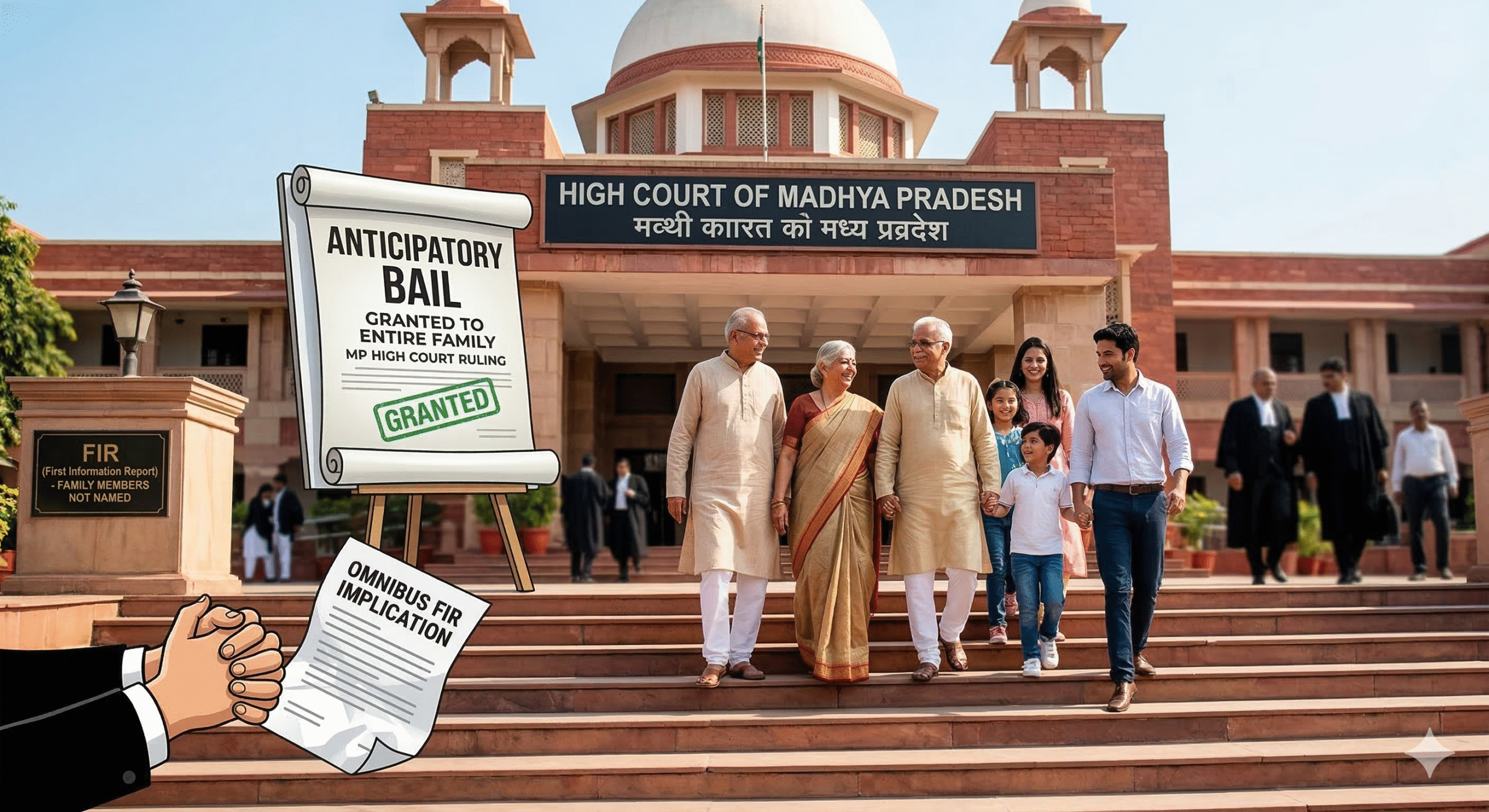
One of the most persistent concerns in Indian criminal law is the practice of roping in an entire family as accused persons in disputes that are primarily directed against specific individuals. When an FIR names certain persons and others are subsequently added — without any specific role being attributed to them — the law demands a careful and individualized scrutiny of each person’s alleged participation before their liberty can be curtailed. The High Court of Madhya Pradesh at Jabalpur once again applied this principle firmly in MCRC No. 2011 of 2026, the fourth order to emerge from the same FIR — Crime No. 914/2025, District Sidhi — that has now been the subject of multiple bail orders by the High Court.
Background of the Case
The applicants — Shailbahadur Saket and Others — filed their first application under Section 482 of the Bharatiya Nagarik Suraksha Sanhita, 2023 seeking anticipatory bail in connection with Crime No. 914/2025 registered at Police Station Kotwali, District Sidhi, Madhya Pradesh.
The offences alleged were under the following provisions of the Bharatiya Nyaya Sanhita, 2023:
| Section | Subject |
|---|---|
| Section 103(1) | Murder |
| Section 115(2) | Voluntarily causing grievous hurt |
| Section 118(1) | Hurt by dangerous weapons |
| Section 296 | Obscene acts |
| Section 333 | House trespass to commit offence |
| Section 351(3) | Criminal intimidation |
| Section 109 | Attempt to commit offences |
The Broader Context — A Series of Bail Orders From the Same FIR
This order is the fourth anticipatory bail order arising from Crime No. 914/2025. The High Court had previously dealt with the same FIR in the following matters:
| Case | Applicant | Order |
|---|---|---|
| MCRC 57269/2025 | Trilok Prasad Saket | Anticipatory bail granted — 16.12.2025 |
| MCRC 53656/2025 | Another co-accused | Anticipatory bail granted — 18.11.2025 |
| MCRC 2643/2026 | Angad Prasad Saket | Anticipatory bail granted — 29.01.2026 |
| MCRC 2011/2026 | Shailbahadur Saket and Others | Anticipatory bail granted — 29.01.2026 |
This consistent pattern of bail grants across multiple accused persons from the same FIR is itself a significant indicator of how the Court assessed the prosecution’s case overall.
Key Facts
The factual foundation of the applicants’ case rested on two decisive circumstances:
1. Not Named in the Original FIR The FIR was lodged on 23 October 2025. The applicants did not find place in the original FIR. They were subsequently made accused — along with what appears to be the entire family — in the aftermath of the FIR. This pattern of adding family members after the initial registration of a case is a well-recognized concern in criminal law.
2. No Specific Role Assigned The specific allegations in the case were directed against named co-accused persons — Bhagwat Saket, Trilok Saket, Ramswaroop Saket, Iswardeen Saket and Krishna Kumar Saket. No active or specific role was attributed to the present applicants anywhere in the prosecution’s case.
Additionally, the other co-accused persons from the same FIR had already been granted anticipatory bail by the High Court — creating a strong parity argument in favour of the applicants.
Submissions on Behalf of the Applicants
Senior Advocate Shri Mrigendra Singh Baghel, appearing with Ms. Akanksha Singh Chauhan, placed the following arguments before the Court:
1. Absent from the FIR — Added Subsequently The applicants were not named when the FIR was first lodged. The subsequent addition of the entire family as accused persons, without any specific allegation against each of them, was a classic instance of omnibus implication in a family dispute.
2. No Active Role Attributed The prosecution’s own case assigned specific roles to other named accused persons. The applicants had no active role attributed to them anywhere in the case.
3. Parity with Co-Accused Already on Bail Multiple co-accused persons from the same FIR had already been granted anticipatory bail by the High Court. The applicants’ position was no different — and was in fact stronger, given that they were not even named in the original FIR.
State’s Opposition
The learned Panel Lawyer for the State opposed the application, submitting that the applicants’ names appeared in the statement of the victim recorded on 23 October 2025 — the same date as the FIR — and that the victim had supported the prosecution case in her statement. It was urged that this disentitled the applicants from anticipatory bail.
The Court’s Decision
Hon’ble Justice Devnarayan Mishra, after hearing both sides and perusing the case diary, recorded a clear and unambiguous finding:
“No specific role has been assigned to the applicants and in the FIR, their names do not find place and no active role has been assigned to the applicants.”
On the basis of this finding and the overall facts and circumstances on record, the Court deemed it fit to grant anticipatory bail and allowed the application — without commenting on the merits of the case.
Directions issued by the Court:
- In the event of arrest, each applicant shall be released on bail upon furnishing a personal bond of Rs. 50,000/- (Rupees Fifty Thousand) with one solvent surety of the like amount each, to the satisfaction of the Arresting Officer
- The applicants shall cooperate with the investigating agency and appear before the Investigating Officer on dates and times directed
- The applicants shall not directly or indirectly induce or threaten any prosecution witness
- The applicants shall regularly appear before the trial Court and cooperate till disposal of the case
- The applicants shall abide by all conditions enumerated under Section 482(2) of the BNSS, 2023
Legal Significance of This Order
This order — the fourth arising from the same FIR — carries important legal lessons on several fronts:
① Absence from FIR Combined with No Specific Role — A Decisive Combination The Court’s reasoning in this order is crisp and clear: the applicants were not in the FIR, and no active role was assigned to them. This two-fold finding — absence from the original FIR and absence of any specific overt act — is a combination that Indian courts have consistently treated as a strong ground for anticipatory bail, even in cases involving serious offences.
② Victim’s Statement Naming Accused Not Automatically Sufficient The State’s argument rested on the victim’s statement of 23 October 2025 naming the applicants. The Court did not treat this as sufficient to deny bail. This reflects the established principle that a witness statement — particularly one recorded contemporaneously with a disputed FIR — must be read in its full context, and that a mere mention of a person’s name without a specific role attributed is not, by itself, enough to justify pre-arrest detention.
③ Whole Family Made Accused — A Recognized Concern The Court’s observation that the whole family was made accused subsequent to the FIR reflects a broader judicial concern about the practice of roping in entire families in criminal cases arising from disputes that are fundamentally between specific individuals. Courts have been increasingly vigilant about this pattern.
④ Consistent Judicial Approach Across a Single FIR The fact that the High Court has now granted anticipatory bail to multiple accused persons arising from Crime No. 914/2025 — across four separate orders — reflects a consistent and principled judicial approach to the facts of this case. Practitioners should note that where a Court has consistently granted bail to co-accused persons from the same FIR, the threshold for the remaining accused becomes progressively higher for the prosecution to cross.
⑤ Standard BNSS Conditions — Non-Tampering and Regular Appearance The directions regarding non-interference with prosecution witnesses and regular appearance before the trial Court are standard conditions under Section 482(2) BNSS, reflecting the Court’s effort to balance the grant of liberty with the integrity of the ongoing investigation and trial.
Relevant Legal Provisions
| Provision | Subject |
|---|---|
| Section 482, BNSS 2023 | Anticipatory Bail |
| Section 482(2), BNSS 2023 | Mandatory Conditions for Anticipatory Bail |
| Section 103(1), BNS 2023 | Murder |
| Section 115(2), BNS 2023 | Voluntarily Causing Grievous Hurt |
| Section 118(1), BNS 2023 | Hurt by Dangerous Weapons |
| Section 333, BNS 2023 | House Trespass to Commit Offence |
| Section 351(3), BNS 2023 | Criminal Intimidation |
Conclusion
The Madhya Pradesh High Court’s order in Shailbahadur Saket and Others vs. State of Madhya Pradesh (MCRC 2011/2026) is the fourth and most comprehensive illustration of a principle that runs through all four bail orders arising from Crime No. 914/2025 — that personal liberty cannot be curtailed by the mere act of adding a person’s name to a criminal case without attributing any specific role to them. Whether the person is absent from the FIR entirely, or is present only in a victim’s statement without a specific overt act being alleged, the law demands more before pre-arrest detention can be justified. This series of orders from the MP High Court provides practitioners with a rich and directly applicable body of jurisprudence on anticipatory bail, the parity principle, and the limits of omnibus implication under the BNSS framework.