

Introduction
The power of municipal and local body authorities to inspect commercial premises, issue notices, cancel trade licenses, and seal establishments is an important regulatory tool for protecting public safety. However, this power must be exercised in a procedurally fair manner — with adequate notice, reasonable time for compliance, and proportionate action. When authorities issue a notice giving fifteen days for compliance, only to revisit the premises within two days and proceed to seal them without waiting for the prescribed period to expire, the question of procedural fairness and the principles of natural justice comes sharply into focus. The High Court of Madhya Pradesh at Jabalpur addressed precisely this situation in WP No. 11538 of 2026, filed by Airplaza Retail Holdings Private Limited — a retail establishment — against the cancellation of its trade license and the sealing of its premises.
Background of the Case
The petitioner — Airplaza Retail Holdings Private Limited — filed a writ petition under Article 226 of the Constitution of India seeking the following reliefs:
- A writ of certiorari quashing the challan bearing Book No. 608, Serial No. 018 dated 27 March 2026
- A writ of certiorari quashing the order dated 30 March 2026 cancelling the petitioner’s Trade License — alleged to be arbitrary, illegal, and in violation of the principles of natural justice
- A writ of mandamus directing the respondents to restore the Trade License and permit the petitioner to continue business operations without interference
- A direction restraining the respondents from taking any further coercive action or interfering with the petitioner’s peaceful possession and business operations
- Renewal of the trade license which was expiring on 31 March 2026
Key Facts
The sequence of events that led to the writ petition was as follows:
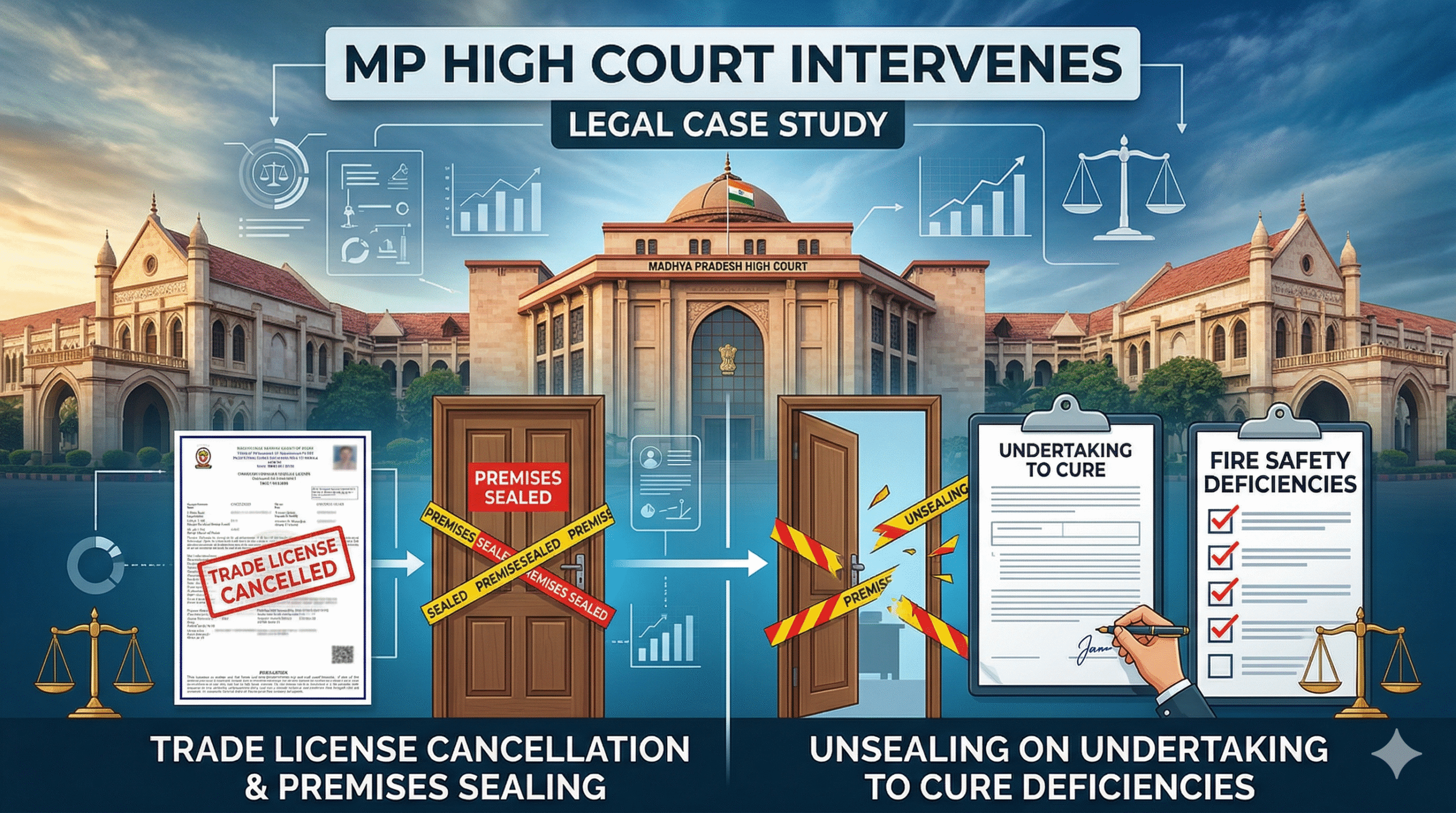
Step 1 — Joint Inspection and Notice with 15 Days’ Time The respondent Corporation carried out a joint inspection of the petitioner’s premises and issued a notice to the petitioner identifying deficiencies — primarily in the fire safety system and other aspects including the unhygienic condition of washrooms. The notice gave the petitioner fifteen days to take corrective action.
Step 2 — Re-Inspection Within Two Days Before the fifteen-day period had even begun to run meaningfully, the authorities revisited the premises within two days of issuing the notice. They found that no progress or improvement had been made.
Step 3 — Premises Sealed On the basis of this second inspection — and citing a recent fire incident in the city that had caused difficulty to the public — the Corporation proceeded to seal the petitioner’s premises, treating the absence of immediate corrective action as sufficient justification.
Step 4 — Trade License Cancelled Simultaneously, the petitioner’s trade license was cancelled vide order dated 30 March 2026 — the day before it was due to expire on 31 March 2026.
The Petitioner’s Grievance
The core grievance of the petitioner before the High Court was the procedural unfairness of the Corporation’s action:
- A notice giving fifteen days for compliance was issued — yet re-inspection occurred within two days of that notice
- The premises were sealed without waiting for the fifteen-day compliance period to expire
- The petitioner is a reputable company doing lawful business, concerned about the loss of business and damage to its reputation
- The action of the Corporation was described as highhanded and disproportionate
The Corporation’s Response — A Notable Concession
The counsel for the respondent Corporation made the following submissions before the Court:
- The joint inspection had revealed fire safety deficiencies and unhygienic washroom conditions
- The re-inspection after one day found no improvement
- The sealing was justified in the larger interest of public safety, particularly in light of a recent fire incident in the city
- Importantly however, counsel fairly submitted that the authorities had no personal agenda against the petitioner
- The Corporation’s counsel further submitted that if the petitioner cooperated by taking corrective measures as required by the notice — particularly regarding the fire safety system and other deficiencies — the seal could be reopened
- It was suggested that a competent officer of the petitioner could file an undertaking to take corrective measures within a prescribed period
The Court’s Decision
Hon’ble Justice Sandeep N. Bhatt, after hearing both sides and perusing the documents, and without expressing a view on the merits of the contentions raised by either party, passed the following directions in the interest of justice:
The seal of the petitioner’s premises shall be opened subject to the following conditions:
- A competent officer of the petitioner — specifically Shri Anand Sharma, Assistant Store Manager — shall file an affidavit/undertaking before the Court and before the Corporation, committing to carry out all necessary corrective works to cure the deficiencies pointed out by the Corporation
- The undertaking shall be accompanied by a power of attorney from the highest authority of the petitioner company by way of a board resolution or other appropriate mode
- The undertaking shall be filed by 08 April 2026 — the very next day
- All corrective measures shall be completed in a satisfactory manner by or before 15 April 2026
- The Corporation shall be entitled to inspect the premises on the evening of 15 April 2026
- If the work is found satisfactory — the Corporation shall do the needful (i.e. restore the trade license)
- If the work is not found satisfactory — the Corporation shall be free to take appropriate action in accordance with law
The writ petition was disposed of with these directions.
Legal Significance of This Order
This order touches upon several important principles of administrative and constitutional law that are directly relevant to businesses, retail establishments, and commercial entities dealing with municipal authorities:
① Natural Justice — Reasonable Time for Compliance Cannot Be Curtailed Where a notice gives fifteen days for compliance, re-inspecting and sealing the premises within two days of that notice — before the prescribed compliance period has expired — raises a serious procedural fairness concern. The principle of natural justice requires that a person be given a genuine and reasonable opportunity to comply before adverse action is taken. The High Court’s intervention reflects this principle.
② Writ of Certiorari Against Arbitrary Municipal Action The writ of certiorari is available to quash orders that are arbitrary, illegal, or passed in violation of natural justice. The cancellation of a trade license without waiting for the compliance period to expire — and without a fair opportunity to remedy the deficiencies — squarely attracts judicial review under Article 226 of the Constitution.
③ Balancing Public Safety Against Business Rights The Court’s approach in this order reflects a careful balance between two legitimate interests — the Corporation’s public safety mandate (particularly in the wake of a recent fire incident) and the petitioner’s right to carry on lawful business without arbitrary interference. Rather than choosing one over the other, the Court devised a solution that served both: the premises are unsealed, but only on a firm commitment to remedy the safety deficiencies within a specific timeframe with an inspection to follow.
④ Undertaking as a Practical Remedy The Court’s direction to file an undertaking before both the Court and the Corporation — backed by a power of attorney from the company’s highest authority — is a practical and effective tool for ensuring compliance without the need for prolonged litigation. It places accountability squarely on the petitioner while restoring business operations pending compliance.
⑤ Post-Compliance Inspection — Keeping the Regulatory Mechanism Intact The Court’s direction for a re-inspection on 15 April 2026 is significant. It does not permanently restrain the Corporation from acting — it merely creates a structured timeline for compliance and verification. If the petitioner fails to remedy deficiencies, the Corporation retains full authority to act in accordance with law. This reflects the Court’s recognition that fire safety and public health regulations serve legitimate and important purposes.
⑥ Fire Safety Compliance — A Growing Area of Regulatory Scrutiny This order comes in the context of a recent fire incident in the city — reflecting a broader trend of heightened regulatory scrutiny of fire safety compliance in commercial establishments across India. Retail businesses, malls, restaurants, and other public-facing establishments should treat this order as a timely reminder of the importance of maintaining up-to-date fire safety systems and responding promptly to municipal notices.
Relevant Legal Provisions and Concepts
| Provision / Concept | Subject |
|---|---|
| Article 226, Constitution of India | High Court’s writ jurisdiction |
| Writ of Certiorari | Quashing of arbitrary/illegal orders |
| Writ of Mandamus | Direction to restore trade license |
| Principles of Natural Justice | Fair hearing and reasonable compliance time |
| Trade License Law | Municipal regulatory framework for commercial establishments |
| Fire Safety Regulations | Compliance obligations for commercial premises |
Conclusion
The Madhya Pradesh High Court’s order in Airplaza Retail Holdings Private Limited vs. State of Madhya Pradesh (WP 11538/2026) is an important illustration of how courts exercise their writ jurisdiction to protect businesses from disproportionate and procedurally unfair municipal action — while simultaneously upholding the legitimate regulatory authority of local bodies in matters of public safety. The Court’s balanced approach — unsealing the premises on an undertaking to comply, with a firm inspection deadline — provides a practical template for resolving similar disputes between commercial establishments and municipal authorities. For businesses, the order is a reminder that fire safety compliance is non-negotiable; for practitioners, it is a useful reference on the principles of natural justice in the context of trade license cancellation and premises sealing.