

Introduction
In an important interim development concerning administrative and service-related rights, the High Court of Madhya Pradesh granted interim protection in WP No. 28600 of 2021, titled The Kotwar Welfare Society Sangh Bhopal vs State of Madhya Pradesh & Others. The Division Bench comprising Hon’ble Chief Justice Suresh Kumar Kait and Hon’ble Justice Vivek Jain passed the order on 07 March 2025.
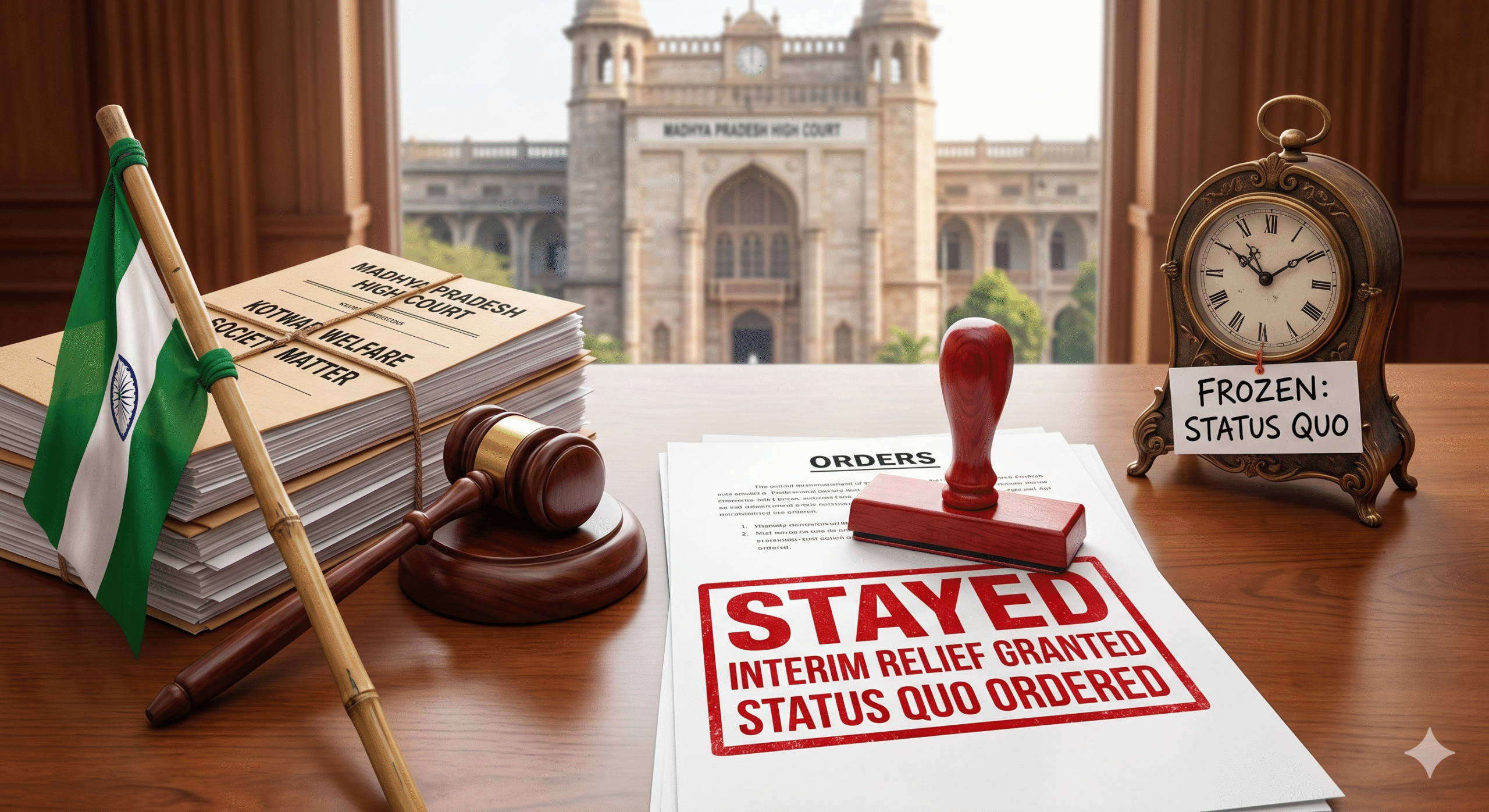
The Court stayed the operation of the impugned orders and directed the parties to maintain status quo until further consideration of the matter. The order reflects the judiciary’s continuing role in preserving legal rights and ensuring fairness during the pendency of constitutional proceedings.
The matter also gains significance because the issue involved was stated to be connected with proceedings already pending before the Court in Writ Appeal No. 34 of 2025, where interim relief had earlier been granted.
Background of the Case
The petition was filed by The Kotwar Welfare Society Sangh Bhopal before the Madhya Pradesh High Court challenging certain impugned orders issued by the authorities.
The petitioner was represented by Advocate Shri Sourabh Pathak, while the State was represented by Shri Abhijeet Awasthi, Deputy Advocate General. During the course of hearing, counsel appearing for the petitioner submitted before the Court that a similar issue was already pending adjudication in Writ Appeal No. 34 of 2025, wherein interim protection had been granted by the Court on 04 February 2025.
Considering the submission and the pendency of related proceedings, the Court directed the respondents to complete instructions within three weeks and granted interim relief in favour of the petitioner.
Interim Protection Granted by the Court
The Division Bench directed that:
- The operation of the impugned orders shall remain stayed; and
- Parties shall maintain status quo as it existed on the date of the order.
The Court further directed that the matter be listed along with Writ Appeal No. 34 of 2025, indicating the interconnected nature of the legal issues involved.
Such interim protection plays a vital role in constitutional litigation, particularly where administrative decisions or governmental actions are challenged before High Courts.
Understanding Stay Orders in Constitutional Proceedings
A stay order issued by a constitutional court temporarily suspends the operation or implementation of an impugned order until further judicial examination takes place.
The purpose of granting a stay is to:
- Prevent irreversible consequences;
- Preserve existing legal rights;
- Avoid administrative prejudice;
- Maintain fairness during litigation.
Courts generally consider several factors while granting interim stay orders, including:
- Existence of a prima facie case;
- Balance of convenience;
- Possibility of irreparable injury;
- Larger public interest considerations.
In the present matter, the Court appears to have considered the pendency of a connected writ appeal and the grant of interim relief in similar proceedings while extending protection to the petitioner.
Importance of Status Quo Directions
In addition to staying the impugned orders, the Court also directed maintenance of status quo. A status quo direction ensures that no party alters the prevailing position during the pendency of proceedings.
Such directions are commonly issued to:
- Prevent unilateral action by parties;
- Preserve the subject matter of litigation;
- Avoid creation of third-party rights;
- Ensure effective final adjudication.
Status quo orders are particularly significant in service, administrative, property, and governance-related disputes where implementation of contested orders may create complications difficult to reverse later.
The interim direction passed in the present case reflects the cautious judicial approach adopted by constitutional courts while balancing competing interests.
Role of High Courts Under Article 226
Under Article 226 of the Constitution of India, High Courts possess extensive powers to issue writs, directions, and orders for enforcement of legal and constitutional rights.
The writ jurisdiction of High Courts serves as an important constitutional safeguard against:
- Arbitrary administrative action;
- Violation of statutory provisions;
- Procedural irregularities;
- Abuse of governmental power.
While exercising jurisdiction under Article 226, High Courts frequently grant interim relief to protect parties from immediate prejudice pending detailed adjudication.
The present order demonstrates how constitutional courts use interim powers to preserve fairness and judicial balance until the dispute is finally heard.
Connected Proceedings and Judicial Consistency
An important aspect of the present matter is the reference to Writ Appeal No. 34 of 2025, where interim protection had already been granted in relation to a similar issue.
Courts often consider connected or analogous proceedings to ensure:
- Judicial consistency;
- Uniformity in interim protection;
- Avoidance of conflicting orders;
- Efficient adjudication of common legal questions.
By directing the present matter to be listed along with the pending writ appeal, the Court ensured coordinated judicial consideration of related issues.
This approach strengthens consistency in constitutional adjudication and promotes procedural efficiency.
Broader Legal Significance
The interim order passed in The Kotwar Welfare Society Sangh Bhopal matter carries broader implications for administrative and constitutional litigation in India.
The order reiterates several important legal principles:
- Interim relief is an essential tool for protecting rights during litigation;
- Courts may stay administrative actions where judicial scrutiny is warranted;
- Status quo directions preserve fairness and prevent prejudice;
- Similar pending matters may influence grant of interim protection.
The decision also highlights the importance of judicial oversight in disputes involving governmental or administrative action affecting groups, associations, or welfare bodies.
Conclusion
The interim order passed by the High Court of Madhya Pradesh in WP No. 28600 of 2021 demonstrates the constitutional court’s role in safeguarding rights pending adjudication of disputes. By staying the operation of the impugned orders and directing maintenance of status quo, the Court ensured preservation of the existing position until further consideration of the matter.
The order also reflects the importance of consistency in judicial proceedings, particularly where similar legal questions are already pending before the Court. Interim protections of this nature continue to play a crucial role in maintaining fairness, preventing irreversible consequences, and preserving the effectiveness of constitutional remedies under Article 226 of the Constitution of India.
As the matter proceeds alongside connected proceedings, the eventual adjudication may provide further clarity on the legal and administrative issues involved in the dispute.