

Introduction
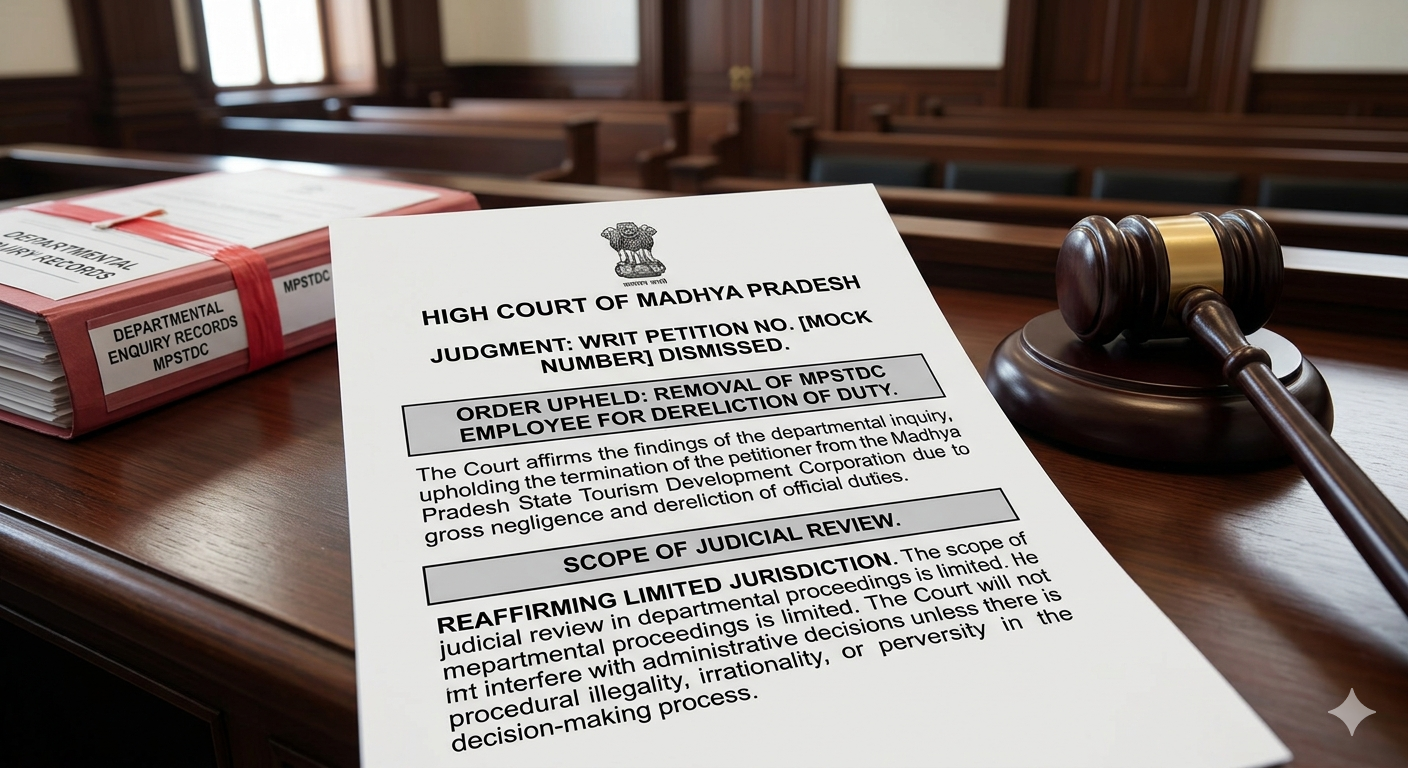
One of the most frequently litigated questions in Indian service law is whether a High Court, exercising its extraordinary writ jurisdiction under Article 226 of the Constitution of India, can sit in appeal over the findings of a disciplinary authority and re-appreciate evidence in departmental proceedings. The answer, consistently given by the Supreme Court and High Courts across the country, is an emphatic no — and the Madhya Pradesh High Court at Jabalpur has once again reinforced this settled legal position in its order dated 3rd May, 2023, in Writ Petition No. 2414 of 2003.
In this case, a petition filed by an employee of the Madhya Pradesh State Tourism Development Corporation (MPSTDC) challenging his removal from service was dismissed after the court found no procedural irregularity, no malafides, and no disproportionality in the punishment awarded following a departmental enquiry.
Background of the Case
The petitioner, R.P. Tiwari, was an employee of the Madhya Pradesh State Tourism Development Corporation Limited, posted at Khajuraho, Madhya Pradesh. By an order dated 24th March, 1998, the Corporation’s Managing Director imposed upon him the penalty of removal from service following a departmental enquiry.
The charges against the petitioner related to an incident of dereliction of duty. It was alleged that on 14th September, 1993, the petitioner had driven the Corporation’s bus from the depot to a hotel to board passengers for a scheduled trip from Khajuraho to Jhansi. However, after passengers had boarded the bus, the petitioner refused to drive the vehicle. This conduct caused significant inconvenience to passengers who had booked their tickets and damaged the reputation of the Corporation.
The petitioner approached the Madhya Pradesh High Court by way of a writ petition nearly five years after the removal order, seeking quashing of the punishment and reinstatement with all consequential service benefits.
Petitioner’s Contentions
The petitioner raised the following principal grounds before the High Court:
1. Non-Supply of Documents: The petitioner alleged that during the course of the departmental enquiry, he was not provided with a complete set of relevant documents. He contended that this non-furnishing of documents caused material prejudice to his ability to defend himself and amounted to a violation of natural justice.
2. Inconsistency in Dates of the Incident: The petitioner also argued that the charge sheet did not mention a specific date of the alleged incident. According to him, the incident was initially attributed to 10th September, 1993, but was subsequently altered to 14th September, 1993 and 15th September, 1993 — a discrepancy that, he submitted, undermined the credibility of the charges.
On the basis of these contentions, the petitioner sought quashing of the removal order and reinstatement with all service benefits.
Respondent’s Arguments (Represented by Shri Sourabh Pathak)
Shri Sourabh Pathak, appearing as learned counsel on behalf of the respondent Corporation, raised a preliminary objection as well as substantive arguments on merits:
Statutory Remedy Not Exhausted: The first and foremost submission was that the impugned order of punishment was an appealable order under Rule 43 of the Madhya Pradesh State Tourism Development Corporation Limited Service Bye-Laws, 1979. Under Bye-Law 48, an appeal against the order of the Managing Director lies to the Board of Directors. Since the petitioner had not availed of this statutory remedy of appeal before approaching the High Court, the writ petition was not maintainable.
Limited Scope of Judicial Review: It was further argued that the scope of judicial review in matters of departmental enquiry is extremely limited. Reliance was placed on the judgment of a coordinate Bench of the Madhya Pradesh High Court in Procter and Gamble Hygiene and Health Care Ltd. vs. C.C. & C. Ex., Bhopal [2002 SCC Online MP 796], which held that when a statutory forum or tribunal has been specially created for redress of specific grievances, the High Court should not ordinarily entertain petitions under Article 226 of the Constitution.
Court’s Analysis and Findings
Hon’ble Justice Vivek Agarwal carefully examined the record of the departmental enquiry proceedings and heard both sides at length. The court’s findings were clear and decisive on each of the petitioner’s contentions:
On the Non-Supply of Documents:
The court repeatedly asked the petitioner’s counsel, Shri Ankit Chopra, to point out any document on record to show that the petitioner had raised an objection before the inquiry officer about non-furnishing of documents during the inquiry. The petitioner’s counsel could produce only documents that pre-dated the petitioner’s appearance before the inquiry officer and documents issued after the show-cause notice was served — but was entirely unable to produce any record showing that a contemporaneous objection about non-supply of documents was ever raised before the inquiry officer.
Furthermore, the court noted that upon perusing the enquiry report and the proceedings of the inquiry as placed on record by the Corporation, there was not even a suggestion that the non-furnishing of documents had deprived the petitioner of the ability to effectively cross-examine the prosecution witnesses.
Most significantly, the court noted that the Managing Director, in his impugned order, had specifically recorded that — in order to afford a further opportunity to the petitioner — the relevant documents were again supplied to him and he was given an opportunity for a personal hearing. The petitioner, however, failed to avail himself of that opportunity without assigning any reason.
On the Merits of the Disciplinary Action:
The court held that a High Court exercising writ jurisdiction under Article 226 is not a second court of appeal over the findings of the disciplinary authority. The petitioner had admittedly displayed dereliction of duty. It was established that he took the Corporation’s bus from the depot to the hotel for boarding passengers on 14th September, 1993, and thereafter, after passengers had boarded, refused to drive the vehicle. This, the court concluded, clearly constituted dereliction of duty.
The court found that the departmental enquiry was not vitiated by any procedural vice and the order of punishment was not disproportionate or shocking to the judicial conscience.
On Judicial Review:
Relying upon the Supreme Court’s authoritative judgment in Union of India and Others vs. P. Gunasekaran [(2015) 2 SCC 610], the court reiterated that the scope of judicial review in service matters arising out of departmental enquiries is limited. The High Court will not interfere unless:
- The enquiry was held in violation of principles of natural justice;
- The authority acted malafidely;
- The findings were perverse; or
- The punishment was shockingly disproportionate.
None of these exceptional grounds were made out in the present case. There was no allegation of malafides, no lack of authority on the part of the Managing Director to pass the removal order, and no legal or technical lacuna in the disciplinary proceedings.
Final Order
The writ petition filed by the petitioner was dismissed.
The court held that the petition failed on facts as well as on law. The petitioner had failed to adduce proper evidence to discard the charges framed against him during the departmental enquiry, and no ground for judicial review under Article 226 of the Constitution was made out.
Legal Significance and Takeaway
This judgment serves as an important reaffirmation of several well-established principles of Indian service and administrative law:
1. Exhaustion of Statutory Remedies is a Prerequisite: Employees aggrieved by disciplinary orders must first exhaust the statutory remedy of appeal provided under the relevant service rules or bye-laws before approaching the High Court in writ jurisdiction. Bypassing the designated appellate forum is a ground for dismissal of the writ petition at the threshold.
2. Objections During Enquiry Must Be Contemporaneous: A plea of non-supply of documents or violation of natural justice cannot be raised for the first time before the High Court if it was never raised before the inquiry officer during the enquiry proceedings. Courts are not sympathetic to such belated objections.
3. Limited Scope of Writ Court in Service Matters: As conclusively settled by the Supreme Court in P. Gunasekaran (2015) 2 SCC 610, a High Court sitting under Article 226 does not function as a court of appeal over the conclusions of a disciplinary authority. It can only examine whether the enquiry was conducted fairly, whether the authority acted within its jurisdiction, and whether the punishment is grossly disproportionate — it cannot re-examine evidence or substitute its own view for that of the disciplinary authority.
4. Personal Hearing Opportunities Must Be Availed: When an employer goes out of its way to supply documents afresh and offer an additional personal hearing, the failure of the employee to avail that opportunity — without any explanation — substantially weakens any subsequent plea of violation of natural justice.
Conclusion
The Madhya Pradesh High Court’s order in Writ Petition No. 2414 of 2003 is a textbook illustration of how Indian courts approach challenges to disciplinary action in service matters. The petitioner’s case suffered from multiple fatal weaknesses — he had not exhausted the statutory appeal provided under the Corporation’s own bye-laws, he had raised the plea of non-supply of documents for the first time before the High Court without ever having objected during the enquiry itself, and most critically, he had failed to avail a fresh personal hearing opportunity that the Corporation had voluntarily offered him.
The court’s reliance on the Supreme Court’s ruling in P. Gunasekaran (2015) 2 SCC 610 underscores a principle that every employee and employer must understand: a High Court under Article 226 is not a forum to re-litigate the facts of a departmental enquiry. Its role is supervisory, not appellate. So long as the enquiry is conducted fairly, the authority acts within its jurisdiction, and the punishment is not shockingly disproportionate, the writ court will not interfere.
For employers and corporations, this judgment reinforces the importance of conducting departmental enquiries in a procedurally sound manner — supplying documents, affording hearings, and recording the employee’s responses or failure to respond. For employees, it is an equally important reminder that procedural rights must be asserted at the right stage, before the right forum, and cannot be reserved as a last resort before the High Court.