

Introduction
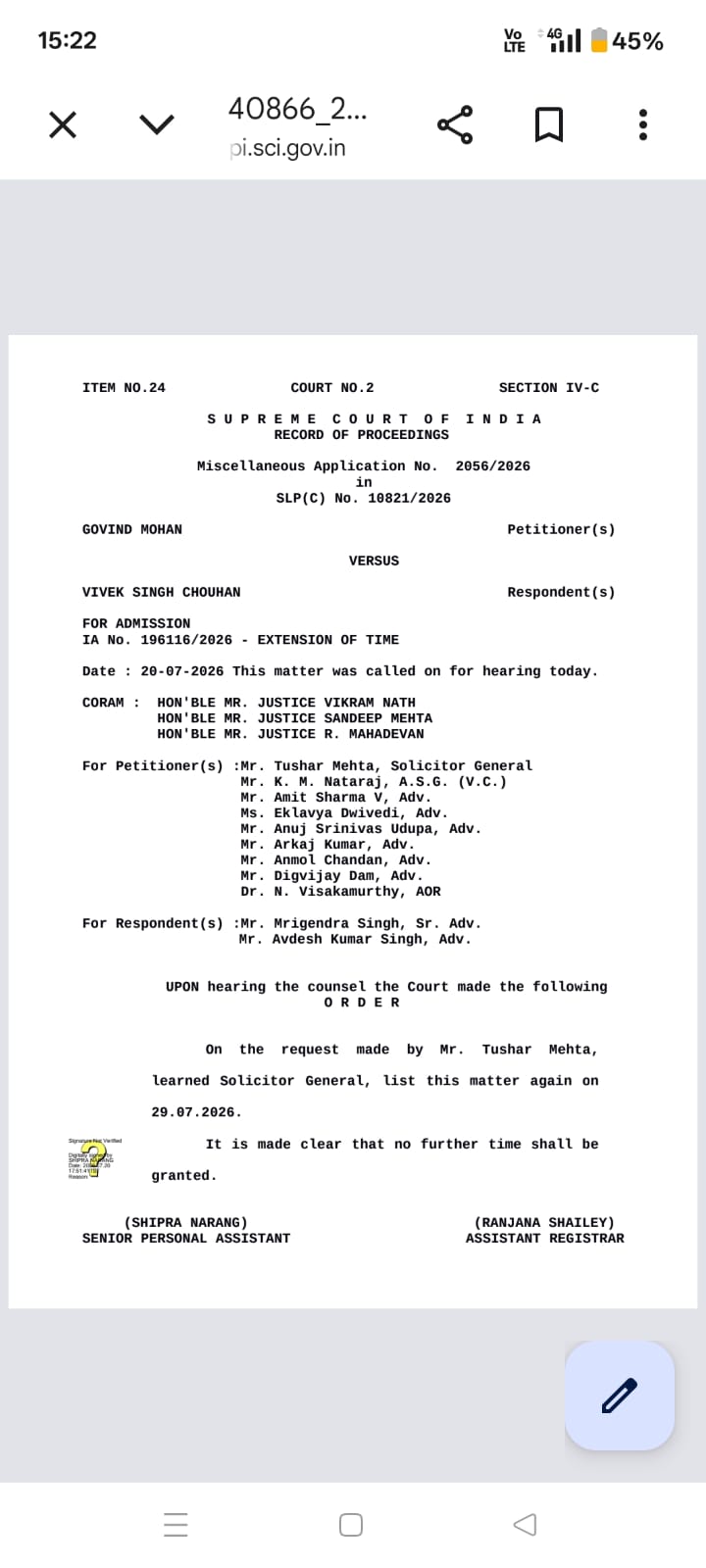
When the Supreme Court of India — through a Three-Judge Bench — records that “no further time shall be granted”, it sends an unambiguous signal to the party seeking compliance extensions that judicial patience has reached its limit. This firm and pointed observation, made on 20 July 2026 in the matter of Govind Mohan vs. Vivek Singh Chouhan, brings to a decisive stage a long-running battle for the enforcement of a High Court direction to grant a Gallantry award to a deserving recipient. This order must be read as the culmination of a litigation journey that began with a writ petition, proceeded through a contempt finding by the MP High Court Indore Bench, and has now reached the highest court of the land — with the Solicitor General of India representing the government.
The Complete Litigation Journey — A Three-Court Story
This Supreme Court order is the latest chapter in a case that has traversed three courts over nearly two years:
| Stage | Court | Date | Development |
|---|---|---|---|
| Writ Petition (WP No. 10038/2024) | MP High Court, Indore | 09.12.2024 | Direction issued to grant Gallantry award |
| Contempt Petition (CONC 771/2025) | MP High Court, Indore | 16.02.2026 | Respondent held prima facie guilty of contempt |
| SLP(C) No. 10821/2026 | Supreme Court of India | 26.03.2026 | Government granted six weeks to comply |
| CONC 771/2025 — Further hearing | MP High Court, Indore | 11.05.2026 | Court noted continued non-compliance; matter listed for sentencing on 30.06.2026 |
| MA 2056/2026 in SLP(C) 10821/2026 | Supreme Court of India | 20.07.2026 | Further time refused; matter listed on 29.07.2026; no further time shall be granted |
The Parties Before the Supreme Court
The appearance list in this order is itself remarkable and underscores the gravity of the matter:
For the Petitioner (Government):
- Mr. Tushar Mehta — Solicitor General of India
- Mr. K.M. Nataraj — Additional Solicitor General (appearing through VC)
- Mr. Amit Sharma V, Advocate
- Ms. Eklavya Dwivedi, Advocate
- Mr. Anuj Srinivas Udupa, Advocate
- Mr. Arkaj Kumar, Advocate
- Mr. Anmol Chandan, Advocate
- Mr. Digvijay Dam, Advocate
- Dr. N. Visakamurthy — AOR
For the Respondent (Vivek Singh Chouhan):
- Mr. Mrigendra Singh — Senior Advocate
- Mr. Avdesh Kumar Singh, Advocate
The deployment of the Solicitor General of India — the second highest law officer of the Union — to appear before the Supreme Court in this matter underscores the seriousness with which the government views the contempt proceedings arising from the non-grant of the Gallantry award.
The Supreme Court’s Order
The Three-Judge Bench — comprising Hon’ble Justice Vikram Nath, Hon’ble Justice Sandeep Mehta, and Hon’ble Justice R. Mahadevan — passed the following order:
“On the request made by Mr. Tushar Mehta, learned Solicitor General, list this matter again on 29.07.2026.
It is made clear that no further time shall be granted.”
The order is brief — but its significance is profound. The Solicitor General himself sought one more listing — and the Court acceded to that request but accompanied it with a clear and categorical warning: no further time shall be granted. This is the Supreme Court’s final signal that the matter will be brought to a conclusion on 29 July 2026, one way or the other.
Legal Significance of This Order
① Solicitor General’s Personal Appearance — Reflecting Government Accountability
The Solicitor General of India appearing in a contempt matter arising from the non-grant of a Gallantry award is a significant development. It reflects the Supreme Court’s view of the matter’s seriousness and the government’s recognition that compliance can no longer be delayed without consequence at the highest level.
② Three-Judge Bench — Enhanced Judicial Gravity
The matter being heard by a Three-Judge Bench of the Supreme Court — as opposed to a standard Two-Judge Bench — reflects the constitutional and institutional significance of the compliance question. A Three-Judge Bench’s categorical finding that no further time shall be granted carries extraordinary weight.
③ “No Further Time Shall Be Granted” — A Final Warning
This phrase is among the most significant that a Supreme Court Bench can use in a compliance/contempt context. It signals that the Court has exhausted its patience with repeated adjournments and extensions, and that the hearing on 29 July 2026 will be decisive. For the government, this is the last opportunity to comply before facing the full consequences of contempt.
④ The Gallantry Award — A Constitutional Entitlement
A Gallantry award directed by a constitutional court is not merely an administrative matter — it is a judicial entitlement. The State’s persistent failure to comply with a court direction to grant such an award, even after the matter reached the Supreme Court and the Solicitor General appeared in person, raises serious questions about institutional compliance culture that the Supreme Court is evidently determined to address.
⑤ Contempt as a Last Resort Enforcement Mechanism
This case illustrates how contempt proceedings function in practice — not as the first resort, but as the last and most powerful tool when all other avenues of persuasion and extension have been exhausted. The progression from writ petition to contempt to prima facie finding to SLP to final warning in the Supreme Court is the complete arc of judicial enforcement.
⑥ Respondent’s Position — Holding the State Accountable
Throughout this litigation, the respondent — Vivek Singh Chouhan — has been the party whose entitlement remains unfulfilled. Shri Mrigendra Singh’s appearance before the Supreme Court as Senior Advocate for the respondent, opposite the Solicitor General of India, reflects the significance of the advocacy required to hold the State accountable before the highest court.
Relevant Legal Provisions and Concepts
| Provision / Concept | Subject |
|---|---|
| Article 136, Constitution of India | Special Leave Petition before the Supreme Court |
| Article 226, Constitution of India | Writ jurisdiction of the High Court (original direction) |
| Contempt of Courts Act, 1971 | Civil contempt for non-compliance |
| Article 142, Constitution of India | Supreme Court’s power to do complete justice |
Conclusion
The Supreme Court’s order dated 20 July 2026 in Govind Mohan vs. Vivek Singh Chouhan (MA 2056/2026 in SLP(C) 10821/2026) marks the final stage of a remarkable and instructive litigation journey — from a writ petition in the MP High Court, through a contempt finding, to the steps of the Supreme Court where the Solicitor General of India himself sought one last listing and was granted it — but with the clearest possible warning that no further time shall be granted. The hearing on 29 July 2026 will bring this matter to its conclusion. For practitioners, constitutional law scholars, and observers of judicial enforcement mechanisms, this case is a textbook illustration of how Indian courts protect their directions from administrative non-compliance — all the way up to the Supreme Court if necessary.